
Search results:
General Information
| Gene_Symbol | Gene_ID | Gene_Name | Chromosome | Alias |
|---|---|---|---|---|
| MDM2 | 4193 | MDM2 proto-oncogene, E3 ubiquitin protein ligase | 12 | HDM2, MGC5370 |
- Evidence
- Gene
- mRNA
- CDS
- Protein
- PTM
- Enzyme
- PPi
- Pathway
- Structural
- Domain
- Ontology
- SNP
- Drug
- External Links
Evidence Information
| Pubmed ID | Year | Sample Information | Techniques | Mechanism | Fold Change | Remark |
|---|---|---|---|---|---|---|
| 23912932 | 2013 | Cell line : - Source : PubMed, Embase,ISI Web of Science and CNKI. Sample Type : Population based case control study No. of Sample : 4,050 CRC and 3,688 controls Stage : - | Meta analysis | Polymorhpism | - | meta-analysis suggests that MDM2 SNP309 Polymorphism was associated with CRC susceptibility, especially among Asians. |
| 24098760 | 2013 | Cell line : - Source : PubMed, EMBASE, and Chinese Biomedical Literature database (CBM) databases. Sample Type : Population based case control study No. of Sample : 4460 CRC and 4828 controls Stage : - | Odds ratios | Polymorhpism | - | Meta-analysis suggests that the MDM2 is a Candidate gene for CRC susceptibility. The MDM2 SNP309 polymorphism may be a risk factor for CRC in Asians. |
| 24797837 | 2014 | Cell line : - Source : First Affiliated Hospital of Nanjing Medical University, Nanjing, China. Sample Type : Population based case control study No. of Sample : 573 CRC and 588 controls Stage : - | Meta analysis,Genotyping | Polymorhpism | - | MDM2 SNP309 polymorphism was significantly associated with CRC risk. |
| 25435368 | 2015 | Cell line : - Source : Algerian population Sample Type : Population based case control study No. of Sample : 116 CRC and 121 controls Stage : - | RFLP-PCR | Polymorhpism | - | Mdm2(SNP309-)(G) allele significantly impacts CRC through mechanisms outside the p53 pathway.MDM2 SNP309 GG genotype is associated with decreased risk of colorectal cancer. |
Gene Details
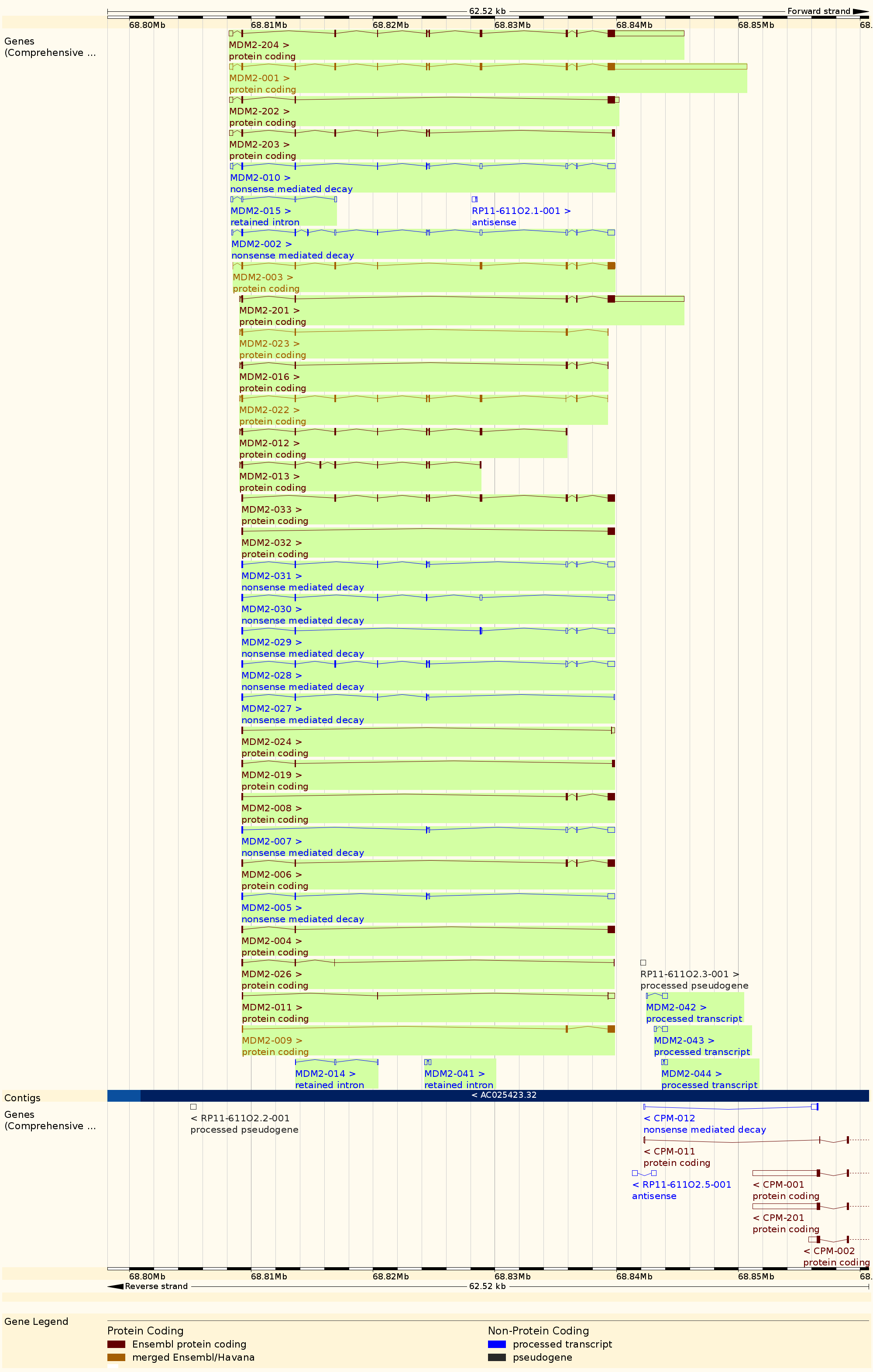
| Gene Type | protein coding |
|---|---|
| Gene Family | - |
| Description | This gene encodes a nuclear-localized E3 ubiquitin ligase. The encoded protein can promote tumor formation by targeting tumor suppressor proteins, such as p53, for proteasomal degradation. This gene is itself transcriptionally-regulated by p53. Overexpression or amplification of this locus is detected in a variety of different cancers. There is a pseudogene for this gene on chromosome 2. Alternative splicing results in a multitude of transcript variants, many of which may be expressed only in tumor cells. [provided by RefSeq, Jun 2013] |
| Chromosome | 12 |
| Location | 12q13-q14 |
| Start | 69201952 |
| End | 69239324 |
| Strand | + |
| Gene Sequence | Download Select all |
| Length | 37373 |
| OMIM ID | 164785 |
| HGNC ID | HGNC:6973 |
| Unigene ID | Hs.484551 |
| Ensembl ID | ENSG00000135679 |
| PharmGKB ID | PA30718 |
mRNA Information
| mRNA ID | XM_005264323.1 |
|---|---|
| Exon | join(1..744,1772..1819,2613..2839,4719..4860,5438..5488, 6290..6340,7778..7924,28985..29096,77025..77170, 112819..112895,132329..132387,133543..133632, 133926..134021,136122..137635) | mRNA Sequence | Download Select all |
| Length | 3504 |
Protein Information
| Protein ID | XP_005264380.1 |
|---|---|
| Protein Name | MDM2 proto-oncogene, E3 ubiquitin protein ligase |
| Molecular Wt. (Da) | 54733 |
| Protein Sequence | Download Select all |
| Length | 406 |
| Uniprot ID | P21980 |
| Ensembl Protein ID | ENSP00000355330 |
Post-translational Modification Information (Source : HPRD)
| Residue | Type | site |
|---|---|---|
| S | Phosphorylation | 172 |
| S | Phosphorylation | 192 |
| S | Phosphorylation | 172 |
| Y | Phosphorylation | 400 |
| K | Sumoylation | 188 |
| K | Sumoylation | 204 |
| K | Sumoylation | 134 |
| S | Phosphorylation | 401 |
| K | Sumoylation | 191 |
| D | Proteolytic Cleavage | 367 |
| S | Phosphorylation | 166 |
| S | Phosphorylation | 166 |
Enzyme Information
No matching records could be found.
PPi Information
(Click to view network : Source STRING) View
| Interactant Gene ID (Source: HPRD) | Gene Symbol | HPRD ID | Ref Seq ID | Technique | References |
|---|---|---|---|---|---|
| 156 | ADRBK1 | 182 | NP_001610.2 | in vivo | 17006543 |
| 409 | ARRB2 | 147 | NP_004304.1 | in vivo | 125 385 961 248 844 000 000 000 |
| 1387 | CREBBP | 2534 | NP_004371.2 | in vitro | 9809062 |
| 1488 | CTBP2 | 4016 | NP_073713.2 | in vitro;in vivo | 12867035 |
| 2099 | ESR1 | 589 | NP_000116.2 | in vitro | 1 076 616 311 178 980 |
| 2908 | NR3C1 | 679 | NP_001019265.1 | in vivo | 11562347 |
| 4869 | NPM1 | 1246 | NP_002511.1 | in vitro;in vivo | 15144954 |
| 5371 | PML | 23 | NP_150241.2 | in vitro;in vivo | 14 507 915 151 951 000 000 000 000 000 000 |
| 7314 | UBB | 6771 | NP_061828.1 | yeast 2-hybrid | 17290220 |
| 7319 | UBE2A | 2422 | NP_003327.2 | in vivo | 12640129 |
| 7874 | USP7 | 3950 | NP_003461.2 | in vitro;in vivo | 15 916 963 168 453 800 000 000 000 000 000 |
| 9099 | USP2 | 5287 | NP_004196.4 | in vitro;in vivo;yeast 2-hybrid | 17290220 |
| 10987 | COPS5 | 6888 | NP_006828.2 | in vitro;in vivo | 17879958 |
| 56893 | UBQLN4 | 5670 | NP_064516.2 | yeast 2-hybrid | 17290220 |
Pathway Information
| Pathway Name | Pathway ID |
|---|---|
| Bladder cancer | hsa05219 |
| Cell cycle | hsa04110 |
| Chronic myeloid leukemia | hsa05220 |
| Endocytosis | hsa04144 |
| Epstein-Barr virus infection | hsa05169 |
| FoxO signaling pathway | hsa04068 |
| Glioma | hsa05214 |
| Melanoma | hsa05218 |
| MicroRNAs in cancer | hsa05206 |
| p53 signaling pathway | hsa04115 |
| Pathways in cancer | hsa05200 |
| PI3K-Akt signaling pathway | hsa04151 |
| Prostate cancer | hsa05215 |
| Proteoglycans in cancer | hsa05205 |
| Thyroid hormone signaling pathway | hsa04919 |
| Transcriptional misregulation in cancer | hsa05202 |
| Ubiquitin mediated proteolysis | hsa04120 |
| Viral carcinogenesis | hsa05203 |
Structure Information
No matching records could be found.
Domain Information
| ID | Location | Description |
|---|---|---|
| cd00162 | 438-482 | RING |
| cl17238 | 438-482 | RING superfamily |
| pfam02201 | 40-100 | SWIB |
| cl02489 | 40-100 | SWIB superfamily |
| pfam13920 | 436-483 | zf-C3HC4_3 |
| pfam00641 | 299-327 | zf-RanBP |
| cl02656 | 299-327 | zf-RanBP superfamily |
| pfam13923 | 438-478 | zf-C3HC4_2 |
Ontology Information
| HPRD ID | 2820 |
|---|---|
| Molecular Class | Ubiquitin proteasome system protein |
| Molecular Function | Guanyl-nucleotide exchange factor activity (GO:0005085) |
| Biological Process | Cell communication (GO:0007154); Signal transduction (GO:0007165) |
Drug Information
No matching records could be found.