
Search results:
General Information
| Gene_Symbol | Gene_ID | Gene_Name | Chromosome | Alias |
|---|---|---|---|---|
| PTGS2 | 5743 | Prostaglandin-endoperoxide synthase 2 (prostaglandin G/H synthase and cyclooxygenase) | 1 | COX2; COX-2; PHS-2; PGG/HS; PGHS-2; hCox-2; GRIPGHS |
- Evidence
- Gene
- mRNA
- CDS
- Protein
- PTM
- Enzyme
- PPi
- Pathway
- Structural
- Domain
- Ontology
- SNP
- Drug
- External Links
Evidence Information
| Pubmed ID | Year | Sample Information | Techniques | Mechanism | Fold Change | Remark |
|---|---|---|---|---|---|---|
| 22885178 | 2012 | Cell line : DiFi, LS 174T, CaCo 2, SW 480, HT 29, SW 613 and HCT 116 Source : - Sample Type : - No. of Sample : - Stage : - | Cell extracts, Metabolic labeling and immunoprecipitation, MatrigelTM and invasion assays | Activation | - | Activation of COX-2 signaling especially in cancer associated fibroblasts promotes progression of colonic cancer. COX-2 signaling can be activated by DCA in both normal and cancer associated fibroblasts, the level of activation of COX-2 signaling is significantly greater in cancer associated fibroblasts than that in normal fibroblasts. |
| 22751903 | 2012 | Cell line : - Source : - Sample Type : - No. of Sample : - Stage : - | Genotyping | Polymorhpism | - | Rectal cancer risk was inversely associated with a low inflammation score among PTGS2 rs4648276 (3,934 T > C) variant allele carriers. |
| 22929917 | 2012 | Cell line : - Source : Departments of Surgery and Oncology, King Abdulaziz University Hospital, Saudi Arabia. Sample Type : - No. of Sample : 94 patients with CRC Stage : - | PCR-RFLP | Polymorhpism | - | COX-2 polymorphism revealed GG in 62.5%, GC in 26.2 % and CC genotype was found in 11.3 % of cases. |
| 19205707 | 2009 | Cell line : - Source : Utah, the Northern California Kaiser Permanente Medical Care Program (KPMCP), and the Twin Cities Metropolitan area of Minnesota(colon cancer study only). Sample Type : Population-based case-control studies No. of Sample : Colon case 1,574 and rectal cancer case 79) and controls 2,969 Stage : - | SNP genotyping,Multiple logistic regression models | Polymorhpism | - | C allele of COX2 8473 T > C polymorphism may interact with NSAIDs to reduce risk for colorectal adenoma. |
| 11900248 | 2001 | Cell line : - Source : National Cancer Institute, Cairo University. Sample Type : - No. of Sample : 80 CRC patients Stage : - | - | Up-regulation | - | Recent studies in humans indicate that therapy with specific COX-2 inhibitors might be an effective approach to colorectal cancer prevention and treatment. COX-2, can be used as a molecular target that involved in tumour promotion during colorectal cancer progression. |
| 22553404 | 2012 | Cell line : - Source : - Sample Type : - No. of Sample : - Stage : - | Immunohistochemistry | Up-regulation | - | Cox-2 expression seems to provide useful prognostic information in CRC, while predicting the patients at high risk for recurrent disease. Tumors with high COX-2 expression showed a higher recurrence rate than tumors with no expression . |
| 23898071 | 2013 | Cell line : - Source : - Sample Type : CRC tumor and normal tissue No. of Sample : 60 Normal colorectal mucosa and paired cancerous tissue of CRC Stage : - | Immunohistochemistry | Up-regulation | - | COX-2 expression has shown a significant correlation with tumor stage and hence is assumed to be a prognostic factor in our cohort of colorectal cancer patients. |
| 24383454 | 2014 | Cell line : - Source : - Sample Type : CRC tumor and normal tissue No. of Sample : 128 Stage : TNM Stage II, III,IV | real time RT-PCR | Up-regulation | - | Levels of COX-2 mRNA are found over-expressed in almost 80% of the colorectal tumors, compared to paired adjacent normal colorectal mucosa, suggesting a role of COX-2 as a potential biomarker for cancer risk, whereas inhibitors of COX-2 could be of value in chemoprevention of colon cancer. |
| 15754389 | 2005 | Cell line : - Source : - Sample Type : CRC tumor and normal tissue No. of Sample : 605 CRC Patients Stage : - | Immunohistochemistry | Up-regulation | - | Cyclooxygenase-2 may be associated with tumor progression by modulating the angiogenesis and cancer cell motility and invasive potential in colorectal cancer and it can be used as a possible biomarker. Among 128 cases of colorectal cancer, 87 (67.9%) were positive for cyclooxygenase-2. The expression of cyclooxygenase-2 was significantly correlated with the depth of invasion, stage of disease, and metastasis (lymph node and liver). |
| 23629521 | 2013 | Cell line : - Source : - Sample Type : - No. of Sample : 128 CRC cases Stage : - | real timeRT- PCR (MethyLight), Immunohistochemistry | Up-regulation | - | Immunohistochemical PTGS2 expression in colorectal carcinoma may serve as a predictive biomarker in pathology practice, which may predict stronger benefit from exercise. |
| 12800231 | 2003 | Cell line : - Source : - Sample Type : Colonoscopy-based case-control study No. of Sample : 162 sporadic colorectal adenoma cases and 211 controls Stage : - | Immunohistochemistry | Up-regulation | - | Cyclooxygenase-2 may be associated with tumor progression by madulating the angiogenesis in colorectal cancer tissue and used as a possible biomarker. Among 128 cases of colorectal cancer, 87 were positive for cyclooxygenase-2 (67.9 %), and 49 for VEGF (38.3 %), respectively |
Gene Details
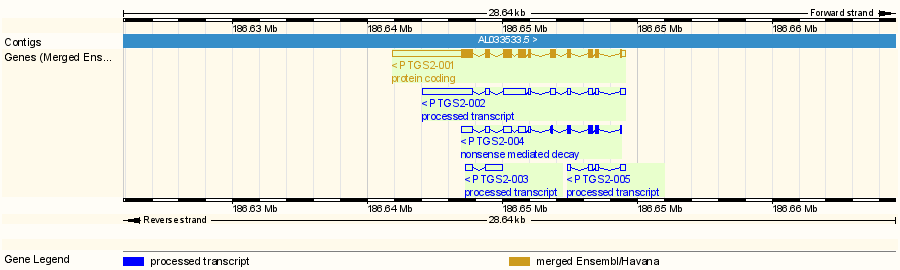
| Gene Type | protein coding |
|---|---|
| Gene Family | - |
| Description | Prostaglandin-endoperoxide synthase (PTGS), also known as cyclooxygenase, is the key enzyme in prostaglandin biosynthesis, and acts both as a dioxygenase and as a peroxidase. There are two isozymes of PTGS: a constitutive PTGS1 and an inducible PTGS2, which differ in their regulation of expression and tissue distribution. This gene encodes the inducible isozyme. It is regulated by specific stimulatory events, suggesting that it is responsible for the prostanoid biosynthesis involved in inflammation and mitogenesis. [provided by RefSeq, Feb 2009] |
| Chromosome | 1 |
| Location | 1q25.2-q25 |
| Start | 186671812 |
| End | 186680427 |
| Strand | - |
| Gene Sequence | Download Select all |
| Length | 8616 |
| OMIM ID | 600262 |
| HGNC ID | HGNC:9605 |
| Unigene ID | Hs.196384 |
| Ensembl ID | ENSG00000073756 |
| PharmGKB ID | PA293 |
mRNA Information
| mRNA ID | NM_000963.3 |
|---|---|
| Exon | join(1..189,990..1106,1227..1370,2024..2167,2598..2779, 3512..3595,3715..3961,4244..4530,5032..5179,5666..8616) | mRNA Sequence | Download Select all |
| Length | 4507 |
CDS Information
| Location | join(138..189,990..1106,1227..1370,2024..2167,2598..2779, 3512..3595,3715..3961,4244..4530,5032..5179,5666..6075) |
|---|---|
| CDS Sequence | Download Select all |
| CCDS ID | CCDS1371.1 |
Protein Information
| Protein ID | NP_000954.1 |
|---|---|
| Protein Name | Prostaglandin-endoperoxide synthase 2 (prostaglandin G/H synthase and cyclooxygenase) |
| Molecular Wt. (Da) | 66643 |
| Protein Sequence | Download Select all |
| Length | 604 |
| Uniprot ID | P07333 |
| Ensembl Protein ID | ENSP00000286301 |
Post-translational Modification Information (Source : HPRD)
No matching records could be found.
Enzyme Information
| EC | 1.14.99.1 |
|---|---|
| Name | prostaglandin-endoperoxide synthase prostaglandin synthase prostaglandin G/H synthase (PG)H synthase PG synthetase prostaglandin synthetase fatty acid cyclooxygenase prostaglandin endoperoxide synthetase |
| Class | Oxidoreductases; Acting on paired donors, with O2 as oxidant and incorporation or reduction of oxygen. The oxygen incorporated need not be derived from O2; Miscellaneous |
| Sysname | (5Z,8Z,11Z,14Z)-icosa-5,8,11,14-tetraenoate,hydrogen-donor:oxygen oxidoreductase |
| Substrate | arachidonate [CPD:C00219]; AH2 [CPD:C00030]; O2 |
| Product | prostaglandin H2 [CPD:C00427]; A [CPD:C00028]; H2O |
| Reaction (IUBMB) |  |
PPi Information
(Click to view network : Source STRING) View
| Interactant Gene ID (Source: HPRD) | Gene Symbol | HPRD ID | Ref Seq ID | Technique | References |
|---|---|---|---|---|---|
| 7157 | TP53 | 1859 | NP_000537.3 | in vivo | 11687965 |
Pathway Information
| Pathway Name | Pathway ID |
|---|---|
| Arachidonic acid metabolism | hsa00590 |
| Chemical carcinogenesis | hsa05204 |
| Leishmaniasis | hsa05140 |
| Metabolic pathways | hsa01100 |
| MicroRNAs in cancer | hsa05206 |
| NF-kappa B signaling pathway | hsa04064 |
| Ovarian steroidogenesis | hsa04913 |
| Oxytocin signaling pathway | hsa04921 |
| Pathways in cancer | hsa05200 |
| Regulation of lipolysis in adipocytes | hsa04923 |
| Retrograde endocannabinoid signaling | hsa04723 |
| Serotonergic synapse | hsa04726 |
| Small cell lung cancer | hsa05222 |
| TNF signaling pathway | hsa04668 |
| VEGF signaling pathway | hsa04370 |
Structure Information
No matching records could be found.
Domain Information
| ID | Location | Description |
|---|---|---|
| cd09816 | 75-562 | prostaglandin_endoperoxide_synthase |
| cl14561 | 75-562 | An_peroxidase_like superfamily |
| cd00054 | 19-54 | EGF_CA |
| cl21504 | 19-54 | EGF_CA superfamily |
| cd05396 | 212-557 | An_peroxidase_like |
| cd09818 | 157-507 | PIOX_like |
| cd09823 | 208-508 | peroxinectin_like |
| cd09822 | 174-508 | peroxinectin_like_bacterial |
| cd09817 | 147-500 | linoleate_diol_synthase_like |
| PLN02283 | 129-497 | PLN02283 |
| cd09820 | 219-496 | dual_peroxidase_like |
| cd09826 | 207-507 | peroxidasin_like |
| cd09825 | 208-335 | thyroid_peroxidase |
| cd09824 | 282-389 | myeloperoxidase_like |
| cd09821 | 283-493 | An_peroxidase_bacterial_2 |
| pfam00008 | 22-53 | EGF |
| pfam03098 | 122-560 | An_peroxidase |
Ontology Information
| HPRD ID | 340 |
|---|---|
| Molecular Class | Enzyme: Synthase |
| Molecular Function | Extracellular matrix structural constituent (GO:0005201) |
| Biological Process | Cell growth and/or maintenance (GO:0008151) |
Drug Information
| Uniprot ID | DrugBank ID | Name | Type |
|---|---|---|---|
| P35354 | DB00005 | Etanercept | BiotechDrug |
| P35354 | DB00035 | Desmopressin | SmallMoleculeDrug |
| P35354 | DB00041 | Aldesleukin | BiotechDrug |
| P35354 | DB00250 | Dapsone | SmallMoleculeDrug |
| P35354 | DB00360 | Tetrahydrobiopterin | SmallMoleculeDrug |
| P35354 | DB00515 | Cisplatin | SmallMoleculeDrug |
| P35354 | DB00620 | Triamcinolone | SmallMoleculeDrug |
| P35354 | DB00720 | Clodronate | SmallMoleculeDrug |
| P35354 | DB00773 | Etoposide | SmallMoleculeDrug |
| P35354 | DB00856 | Chlorphenesin | SmallMoleculeDrug |
| P35354 | DB00884 | Risedronate | SmallMoleculeDrug |
| P35354 | DB00887 | Bumetanide | SmallMoleculeDrug |
| P35354 | DB00963 | Bromfenac | SmallMoleculeDrug |
| P35354 | DB01041 | Thalidomide | SmallMoleculeDrug |
| P35354 | DB01050 | Ibuprofen | SmallMoleculeDrug |
| P35354 | DB01395 | Drospirenone | SmallMoleculeDrug |
| P35354 | DB06774 | Capsaicin | SmallMoleculeDrug |
| P35354 | DB06804 | Nonoxynol-9 | SmallMoleculeDrug |
| P35354 | DB08819 | Tafluprost | SmallMoleculeDrug |
| P35354 | DB00154 | Dihomo-gamma-linolenic acid | SmallMoleculeDrug |
| P35354 | DB00159 | Icosapent | SmallMoleculeDrug |
| P35354 | DB00233 | Aminosalicylic Acid | SmallMoleculeDrug |
| P35354 | DB00244 | Mesalazine | SmallMoleculeDrug |
| P35354 | DB00316 | Acetaminophen | SmallMoleculeDrug |
| P35354 | DB00328 | Indomethacin | SmallMoleculeDrug |
| P35354 | DB00461 | Nabumetone | SmallMoleculeDrug |
| P35354 | DB00465 | Ketorolac | SmallMoleculeDrug |
| P35354 | DB00469 | Tenoxicam | SmallMoleculeDrug |
| P35354 | DB00480 | Lenalidomide | SmallMoleculeDrug |
| P35354 | DB00482 | Celecoxib | SmallMoleculeDrug |
| P35354 | DB00500 | Tolmetin | SmallMoleculeDrug |
| P35354 | DB00554 | Piroxicam | SmallMoleculeDrug |
| P35354 | DB00573 | Fenoprofen | SmallMoleculeDrug |
| P35354 | DB00586 | Diclofenac | SmallMoleculeDrug |
| P35354 | DB00605 | Sulindac | SmallMoleculeDrug |
| P35354 | DB00712 | Flurbiprofen | SmallMoleculeDrug |
| P35354 | DB00749 | Etodolac | SmallMoleculeDrug |
| P35354 | DB00784 | Mefenamic acid | SmallMoleculeDrug |
| P35354 | DB00788 | Naproxen | SmallMoleculeDrug |
| P35354 | DB00795 | Sulfasalazine | SmallMoleculeDrug |
| P35354 | DB00812 | Phenylbutazone | SmallMoleculeDrug |
| P35354 | DB00814 | Meloxicam | SmallMoleculeDrug |
| P35354 | DB00821 | Carprofen | SmallMoleculeDrug |
| P35354 | DB00861 | Diflunisal | SmallMoleculeDrug |
| P35354 | DB00870 | Suprofen | SmallMoleculeDrug |
| P35354 | DB00936 | Salicylic acid | SmallMoleculeDrug |
| P35354 | DB00939 | Meclofenamic acid | SmallMoleculeDrug |
| P35354 | DB00945 | Acetylsalicylic acid | SmallMoleculeDrug |
| P35354 | DB00963 | Bromfenac | SmallMoleculeDrug |
| P35354 | DB00991 | Oxaprozin | SmallMoleculeDrug |
| P35354 | DB01009 | Ketoprofen | SmallMoleculeDrug |
| P35354 | DB01014 | Balsalazide | SmallMoleculeDrug |
| P35354 | DB01041 | Thalidomide | SmallMoleculeDrug |
| P35354 | DB01050 | Ibuprofen | SmallMoleculeDrug |
| P35354 | DB01283 | Lumiracoxib | SmallMoleculeDrug |
| P35354 | DB01397 | Magnesium salicylate | SmallMoleculeDrug |
| P35354 | DB01398 | Salicylate-sodium | SmallMoleculeDrug |
| P35354 | DB01399 | Salsalate | SmallMoleculeDrug |
| P35354 | DB01401 | Trisalicylate-choline | SmallMoleculeDrug |
| P35354 | DB01404 | Ginseng | SmallMoleculeDrug |
| P35354 | DB01419 | Antrafenine | SmallMoleculeDrug |
| P35354 | DB01435 | Antipyrine | SmallMoleculeDrug |
| P35354 | DB01600 | Tiaprofenic acid | SmallMoleculeDrug |
| P35354 | DB01628 | Etoricoxib | SmallMoleculeDrug |
| P35354 | DB04552 | Niflumic Acid | SmallMoleculeDrug |
| P35354 | DB04743 | Nimesulide | SmallMoleculeDrug |
| P35354 | DB06725 | Lornoxicam | SmallMoleculeDrug |
| P35354 | DB06802 | Nepafenac | SmallMoleculeDrug |
| P35354 | DB08439 | Parecoxib | SmallMoleculeDrug |
| P35354 | DB08910 | Pomalidomide | SmallMoleculeDrug |