
Search results:
General Information
- Evidence
- Gene
- mRNA
- CDS
- Protein
- PTM
- Enzyme
- PPi
- Pathway
- Structural
- Domain
- Ontology
- SNP
- Drug
- External Links
Evidence Information
| Pubmed ID | Year | Sample Information | Techniques | Mechanism | Fold Change | Remark |
|---|---|---|---|---|---|---|
| 11166150 | 2001 | Cell line : - Source : - Sample Type : - No. of Sample : - Stage : - | - | Up-regulation | - | Colon carcinoma progression is associated with gradual and significant increases in expression of TGF-beta1 and TGF-beta2 mRNA and proteins. |
| 12209600 | 2002 | Cell line : - Source : Charles River Breeding Laboratories (Montreal, Canada) Sample Type : Weanling male F344 rats No. of Sample : - Stage : - | real time RT-PCR,Immunohistochemistry | Up-regulation | - | - |
| 16886611 | 2006 | Cell line : - Source : Department of Pathology, Elpis Hospital, Athens, Greece. Sample Type : Formalin-fixed paraffin-embedded tissue No. of Sample : Formalin-fixed paraffin-embedded tissue from 49 cases of colon carcinoma. Stage : Duke stageg A,B,C,D | Immunohistochemistry | Up-regulation | - | TGF-beta2 overexpression, due to the activation or deregulation of the TGF-fl signalling pathway. Inactivation of the TGF-beta gene occurs at an early stage of colorectal carcinogenesis, while inactivation of Smad4 is probably a late event. |
Gene Details
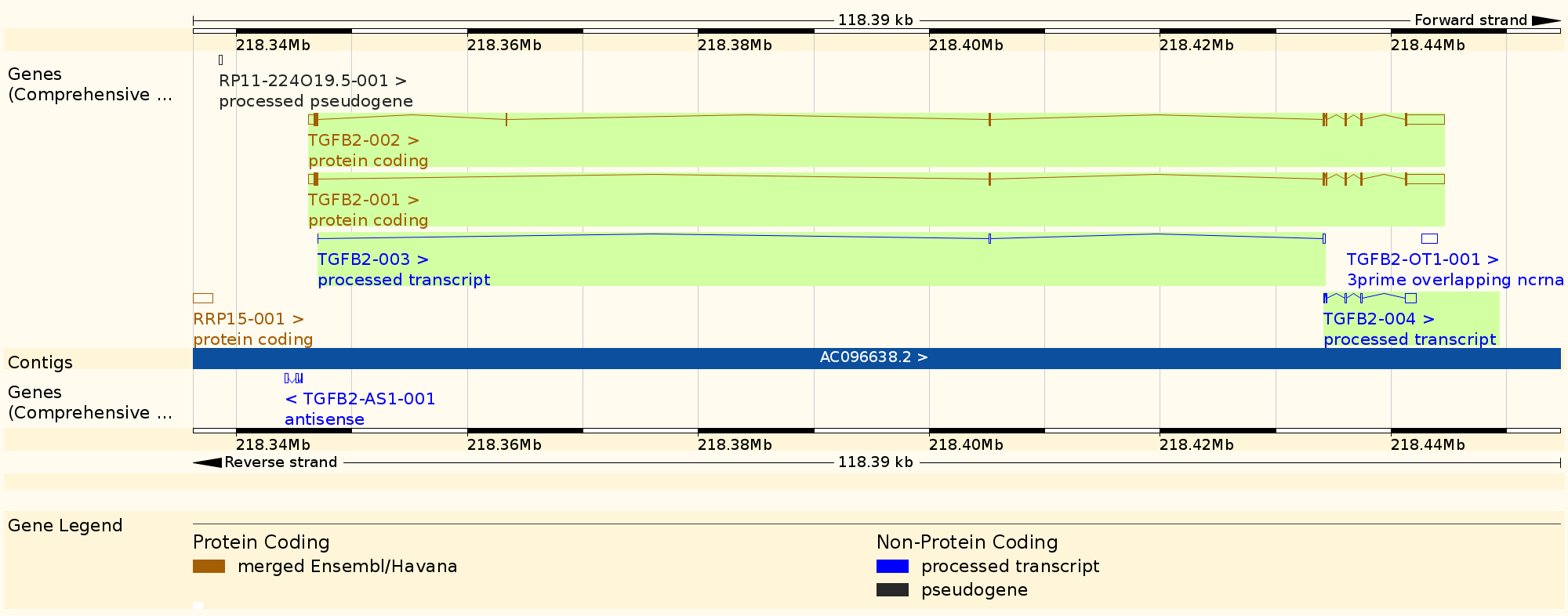
| Gene Type | protein coding |
|---|---|
| Gene Family | Endogenous ligands |
| Description | This gene encodes a member of the transforming growth factor beta (TGFB) family of cytokines, which are multifunctional peptides that regulate proliferation, differentiation, adhesion, migration, and other functions in many cell types by transducing their signal through combinations of transmembrane type I and type II receptors (TGFBR1 and TGFBR2) and their downstream effectors, the SMAD proteins. Disruption of the TGFB/SMAD pathway has been implicated in a variety of human cancers. The encoded protein is secreted and has suppressive effects of interleukin-2 dependent T-cell growth. Translocation t(1;7)(q41;p21) between this gene and HDAC9 is associated with Peters' anomaly, a congenital defect of the anterior chamber of the eye. The knockout mice lacking this gene show perinatal mortality and a wide range of developmental, including cardiac, defects. Alternatively spliced transcript variants encoding different isoforms have been identified. [provided by RefSeq, Sep 2010] |
| Chromosome | 1 |
| Location | 1q41 |
| Start | 218518676 |
| End | 218617961 |
| Strand | + |
| Gene Sequence | Download Select all |
| Length | 99286 |
| OMIM ID | 190220 |
| HGNC ID | HGNC:11768 |
| Unigene ID | Hs.133379 |
| Ensembl ID | ENSG00000092969 |
| PharmGKB ID | PA36482 |
mRNA Information
| mRNA ID | ?NM_001135599.2 |
|---|---|
| Exon | join(1..304,1966..2112,3328..3930) | mRNA Sequence | Download Select all |
| Length | 1054 |
Protein Information
| Protein ID | NP_001129071.1 |
|---|---|
| Protein Name | transforming growth factor, beta 2 |
| Molecular Wt. (Da) | 47197 |
| Protein Sequence | Download Select all |
| Length | 414 |
| Uniprot ID | Q9UQC9 |
| Ensembl Protein ID | ENSP00000359596 |
Post-translational Modification Information (Source : HPRD)
No matching records could be found.
Enzyme Information
No matching records could be found.
PPi Information
No STRING Network could be found.
| Interactant Gene ID (Source: HPRD) | Gene Symbol | HPRD ID | Ref Seq ID | Technique | References |
|---|---|---|---|---|---|
| 351 | APP | 100 | NP_000475.1 | in vivo | 2119582 |
| 650 | BMP2 | 206 | NP_001191.1 | in vivo | 9493905 |
| 1490 | CTGF | 412 | NP_001892.1 | in vivo | 10457363 |
| 2022 | ENG | 565 | NP_001108225.1 | in vitro;in vivo | 12015308 |
| 7040 | TGFB1 | 1821 | NP_000651.3 | in vivo | 11157754 |
| 7046 | TGFBR1 | 1822 | NP_004603.1 | in vivo | 11157754 |
| 7048 | TGFBR2 | 1823 | NP_001020018.1 | in vitro;in vivo | 810 655 311 157 754 |
Pathway Information
| Pathway Name | Pathway ID |
|---|---|
| AGE-RAGE signaling pathway in diabetic complications | hsa04933 |
| Amoebiasis | hsa05146 |
| Cell cycle | hsa04110 |
| Chagas disease (American trypanosomiasis) | hsa05142 |
| Chronic myeloid leukemia | hsa05220 |
| Colorectal cancer | hsa05210 |
| Cytokine-cytokine receptor interaction | hsa04060 |
| Dilated cardiomyopathy | hsa05414 |
| Endocytosis | hsa04144 |
| FoxO signaling pathway | hsa04068 |
| Hepatitis B | hsa05161 |
| Hippo signaling pathway | hsa04390 |
| HTLV-I infection | hsa05166 |
| Hypertrophic cardiomyopathy (HCM) | hsa05410 |
| Inflammatory bowel disease (IBD) | hsa05321 |
| Leishmaniasis | hsa05140 |
| Malaria | hsa05144 |
| MAPK signaling pathway | hsa04010 |
| MicroRNAs in cancer | hsa05206 |
| Osteoclast differentiation | hsa04380 |
| Pancreatic cancer | hsa05212 |
| Pathways in cancer | hsa05200 |
| Proteoglycans in cancer | hsa05205 |
| Renal cell carcinoma | hsa05211 |
| Rheumatoid arthritis | hsa05323 |
| TGF-beta signaling pathway | hsa04350 |
| Toxoplasmosis | hsa05145 |
| Tuberculosis | hsa05152 |
Structure Information
No matching records could be found.
Domain Information
| ID | Location | Description |
|---|---|---|
| pfam00019 | 314-414 | TGF_beta |
| cl02510 | 314-414 | TGF_beta superfamily |
| smart00204 | 317-414 | TGFB |
| pfam00688 | 20-225 | TGFb_propeptide |
| cl02928 | 20-225 | TGFb_propeptide superfamily |
| PHA02913 | 310-413 | PHA02913 |
Ontology Information
| HPRD ID | 14854 |
|---|---|
| Molecular Class | Growth factor |
| Molecular Function | Auxiliary transport protein activity (GO:0015457) |
| Biological Process | Transport (GO:0006810) |
Drug Information
No matching records could be found.