
Search results:
General Information
| Gene_Symbol | Gene_ID | Gene_Name | Chromosome | Alias |
|---|---|---|---|---|
| BMP4 | 652 | Bone morphogenetic protein 4 | 14 | ZYME; BMP2B; OFC11; BMP2B1; MCOPS6 |
- Evidence
- Gene
- mRNA
- CDS
- Protein
- PTM
- Enzyme
- PPi
- Pathway
- Structural
- Domain
- Ontology
- SNP
- Drug
- External Links
Evidence Information
| Pubmed ID | Year | Sample Information | Techniques | Mechanism | Fold Change | Remark |
|---|---|---|---|---|---|---|
| 22383492 | 2012 | Cell line : SW 480, Hela 293 Source : - Sample Type : - No. of Sample : - Stage : - | - | Down-regulation | - | Oncogenic KRAS can downregulate Bmp4 through a transcriptional pathway that depends on ERK. |
| 20949628 | 2011 | Cell line : - Source : National Study of Colorectal Cancer(NSCCG) and the Royal Marsden Hospital NHS Trust Family History and DNA Registry (RMHNHST). Sample Type : - No. of Sample : 504 CRC and 524 Healthy control Stage : - | DNA Sequencing, promoter CpG island methylation by Pyrosequencing, homology modelling | Mutation | - | Identified three pathogenic mutations, p.R286X (g.8330C>T), p.W325C (g.8449G>T) and p.C373S (g.8592G>C), amongst the CRC cases which were not observed in healthy controls. The BMP pathway is inactivated in a large proportion of sporadic CRC. |
| 22170598 | 2012 | Cell line : HCT 116 Source : - Sample Type : - No. of Sample : - Stage : - | Test of heterogeneity, meta-regression, subgroup analysis, cumulative meta-analysis. | Polymorhpism | - | BMP4-rs4444235 polymorphism is probably associated with CRC risk, and C allele is a possible risk factor in overall population.
|
| 21655089 | 2011 | Cell line : - Source : Charles River Laboratories. Sample Type : - No. of Sample : - Stage : - | Genome-wide association studies and SNP selection and genotyping | Polymorhpism | - | Identified new, independent CRC predisposition SNPs close to BMP4 (rs1957636, P = 3.93610210) and BMP2 (rs4813802, P = 4.65610211). GREM1, BMP4 and BMP2 are the targets of the functional variation in each region. Multiple, independently-acting variants close to these loci contribute to CRC risk. |
| 20951698 | 2011 | Cell line : - Source : - Sample Type : - No. of Sample : 504 CRC cases and 524 healthy controls Stage : - | Magnetic Sorting and Flow Cytometry, Immunohistochemistry, Western Blotting, Cell Viability | Unknown | - | BMP4 promotes terminal differentiation, apoptosis, and chemosensitization of CRC-SCs in tumors that do not have simultaneous mutations in Smad4 and constitutive activation of PI3K. BMP4 might be developed as a therapeutic agent against cancer stem cells in advanced colorectal tumors. BMP4 promotes the differentiation of normal colonic stem cells. 25 CRC patient sample of age range 50 -88 year and Mice were obtained from Charles River Laboratories. BMP4 exerts a prodifferentiative effect that prevents CSC expansion and triggers a differentiation program that may result in CSC depletion, thereby hampering tumor development. Data show that the combined use of BMP4 with oxaliplatin and 5-FU is able to obtain complete long-term regression of CRC-SC tumor xenografts. |
| 19321257 | 2009 | Cell line : - Source : CoRGI, RMHNHST, NSCCG, SOCCS. Sample Type : - No. of Sample : 24,910 CRC cases and 26,275 controls. Stage : - | Transfection and expression analysis | Up-regulation | - | BMP-4 is up-regulated in human colonic adenocarcinoma and promotes the invasive phenotypes of human colorectal cancer HCT116 cells. Smad4 is dispensable for enhanced invasiveness of human colorectal cancer cells due to BMP-4 overexpression. Vimentin, a marker of epithelial-mesenchymal transition, and caused the changes of cell morphology, spreading and formation of focal adhesions. BMP-4 overexpressing cells increased cell adhesion on fibronectin and collagen, and augmented cell migration and invasion potentials in comparison to empty-vector controls. 91 genes (65 up-regulated and 26 down-regulated) with 2-fold difference have been identified between BMP-4 overexpressing and empty-vector cells. |
| 21531130 | 2011 | Cell line : - Source : - Sample Type : - No. of Sample : - Stage : - | Peptide Nucleic Acid (PNA)-clamp real-time-PCR TaqMan assay, Gene expression profiles. | Up-regulation | - | - |
Gene Details
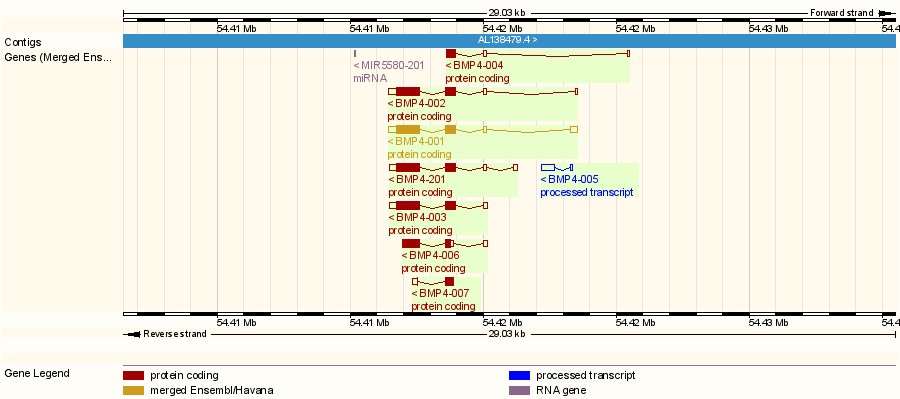
| Gene Type | protein coding |
|---|---|
| Gene Family | Bone morphogenetic proteins |
| Description | The protein encoded by this gene is a member of the bone morphogenetic protein family which is part of the transforming growth factor-beta superfamily. The superfamily includes large families of growth and differentiation factors. Bone morphogenetic proteins were originally identified by an ability of demineralized bone extract to induce endochondral osteogenesis in vivo in an extraskeletal site. This particular family member plays an important role in the onset of endochondral bone formation in humans, and a reduction in expression has been associated with a variety of bone diseases, including the heritable disorder Fibrodysplasia Ossificans Progressiva. Alternative splicing in the 5' untranslated region of this gene has been described and three variants are described, all encoding an identical protein. [provided by RefSeq, Jul 2008] | Chromosome | 14 |
| Location | 14q22-q23 |
| Start | 53949736 |
| End | 53956836 |
| Strand | - |
| Gene Sequence | Download Select all |
| Length | 7101 |
| OMIM ID | 112262 |
| HGNC ID | HGNC:1071 |
| Unigene ID | Hs.68879 |
| Ensembl ID | ENSG00000125378 |
| PharmGKB ID | - |
mRNA Information
| mRNA ID | NM_130850.2 |
|---|---|
| Exon | join(1..78,3437..3561,4608..4984,5949..7101) | mRNA Sequence | Download Select all |
| Length | 1748 |
CDS Information
| Location | join(4615..4984,5949..6805) |
|---|---|
| CDS Sequence | Download Select all |
| CCDS ID | CCDS9715.1 |
Protein Information
| Protein ID | NP_001193.2 |
|---|---|
| Protein Name | Bone morphogenetic protein 4 |
| Molecular Wt. (Da) | 44049 |
| Protein Sequence | Download Select all |
| Length | 408 |
| Uniprot ID | Q9UKV5 |
| Ensembl Protein ID | ENSP00000290649 |
Post-translational Modification Information (Source : HPRD)
No matching records could be found.
Enzyme Information
No matching records could be found.
PPi Information
(Click to view network : Source STRING) View
| Interactant Gene ID (Source: HPRD) | Gene Symbol | HPRD ID | Ref Seq ID | Technique | References |
|---|---|---|---|---|---|
| 633 | BGN | 2359 | NP_001702.1 | in vivo | 1 577 596 915 173 100 |
| 9372 | ZFYVE9 | 4782 | NP_004790.2 | yeast 2-hybrid | 15231748 |
Pathway Information
| Pathway Name | Pathway ID |
|---|---|
| Basal cell carcinoma | hsa05217 |
| Hedgehog signaling pathway | hsa04340 |
| Hippo signaling pathway | hsa04390 |
| Pathways in cancer | hsa05200 |
| Signaling pathways regulating pluripotency of stem cells | hsa04550 |
| TGF-beta signaling pathway | hsa04350 |
| Thyroid hormone signaling pathway | hsa04919 |
Structure Information
No matching records could be found.
Domain Information
| ID | Location | Description |
|---|---|---|
| pfam00688 | 36-275 | TGFb_propeptide |
| cl02928 | 36-275 | TGFb_propeptide superfamily |
| smart00204 | 308-408 | TGFB |
| cl02510 | 308-408 | TGF_beta superfamily |
| pfam00019 | 305-408 | TGF_beta |
| PHA02913 | 308-407 | PHA02913 |
Ontology Information
| HPRD ID | 9130 |
|---|---|
| Molecular Class | Ligand |
| Molecular Function | Ubiquitin-specific protease activity (GO:0004843) |
| Biological Process | Protein metabolism (GO:0019538) |
Drug Information
No matching records could be found.