
Search results:
General Information
| Gene_Symbol | Gene_ID | Gene_Name | Chromosome | Alias |
|---|---|---|---|---|
| CSE1L | 1434 | CSE1 chromosome segregation 1-like (yeast) | 20 | CAS; CSE1; XPO2 |
- Evidence
- Gene
- mRNA
- CDS
- Protein
- PTM
- Enzyme
- PPi
- Pathway
- Structural
- Domain
- Ontology
- SNP
- Drug
- External Links
Evidence Information
| Pubmed ID | Year | Sample Information | Techniques | Mechanism | Fold Change | Remark |
|---|---|---|---|---|---|---|
| 18059182 | 2008 | Cell line : HT 29 Source : - Sample Type : - No. of Sample : - Stage : - | Affymetrix U133 GeneChip expression profiles, Cloning of full length human PPM1H cDNA, RT-PCR analys | Unknown | - | PPM1H controls cell cycle and proliferation of cancer cells potentially through dephosphorylation of CSE1L and might be a new target of anticancer drugs. Sample sets were created from 234 normal and 139 adenocarcinoma samples of colon on the BioExpress database. CSE1L, a proliferation and apoptosis-related protein, as a PPM1H-interacting protein. |
| 20734115 | 2010 | Cell line : - Source : Changhua Christian Hospital, Taiwan. and the American Type Culture Collection (Manassas, VA). Sample Type : Serum sample No. of Sample : 103 Stage : TNM Stage I-IV | GST pull-down experiments , immunoprecipitation assays and Western blotting | Unknown | - | Results showed that CSE1L was differentially stained in the epithelial glands of neoplastic colorectal epithelium, and the staining was related to gland epithelial cell polarization and E-cadherin distribution. CSE1L and E-cadherin distribution in colorectal epithelium glands may be valuable for evaluating the malignance of colorectal disease. |
| 19224336 | 2009 | Cell line : HCT 116, SW 480 Source : - Sample Type : - No. of Sample : - Stage : - | Immunoblotting, Immunofluorescence, Cell secretion assay, CEA and cathepsin D secretion analysis. | Up-regulation | - | CAS overexpression increased the secretion of carcinoembryonic antigen (CEA) and cathepsin D. CAS overexpression induced polarization of HT-29 cells. CAS regulates the secretion of colorectal cells and may regulate the metastasis of colorectal cancer. |
| 20150437 | 2010 | Cell line : - Source : VU University medical center, Amsterdam, The Netherlands. Sample Type : CRC tumor and Normal tissue No. of Sample : - Stage : - | Immunofluorescence, Immunoblotting, Immunohistochemistry, ELISA and Serum CEA Assay. | Up-regulation | - | Assay of serum CSE1L may facilitate diagnosis of colorectal cancer lymphatic metastases; furthermore, CSE1L is a possible therapeutic target. Using serum from 103 patients with stage I, II, III, and IV disease, CSE1L was detected in 36.0% (9 of 25), 57.7% (15 of 26), 71.4% (30 of 42), and 88.9% (8 of 9) of patients, respectively. Serum CSE1L was detected in 74.5% (38 of 51) of patients with lymph node metastasis. 47 control and 103 colorectal patient serum sample from Changhua Christian Hospital, Taiwan. and HT-29 colorectal cancer cells and B16-F10 melanoma cells were obtained from the American Type Culture Collection (Manassas, VA). CSE1L may play a role in secretion by colorectal cancer cells. |
| 22450763 | 2012 | Cell line : - Source : Department of Pathology of Wrocaw Medical University. Sample Type : CRC tumor and Normal tissue No. of Sample : - Stage : - | Immunohistochemistry and real time RT-PCR | Up-regulation | - | CSE1L deplition reduced the viability and adhesion capacity but increase apoptosis in HCT116 and SW480 colorectal cancer cell lines. CSE1L deplition by si RNA treatement in HCT116 and SW80 cell lines shows significant modulation key apoptotic (p53, p73 and BAK) and adhesive (E-cadherin, Ep-CAM and ICAM-1) molecules. CSE1L is associated with viability and apoptosis, cellular adhesion and invasion, thus implicating CSE1L in the progression of colorectal cancer. |
| 22711543 | 2012 | Cell line : SW 620,HCT 116, CCD841CoN Source : - Sample Type : CRC tumor and Normal tissue No. of Sample : 139 CRC and 234 control Stage : TNM Stage I-IV | Immunohistochemistry, genome-wide (microarray-based) DNA and mRNA profiling | Up-regulation | - | Study aimed to investigate whether CSE1L, DIDO1 and RBM39 may drive 20q amplification. The lack of correlation between protein expression levels and 20q DNA copy number status. CSE1L, DIDO1 and RBM39 are located on the 20q amplicon and affect processes such as cell viability and anchorage-independent growth in colorectal cancer. |
| 22968445 | 2012 | Cell line : HT 29 Source : ATCC Sample Type : - No. of Sample : - Stage : - | Laser capture microdissection,FFPE-FASP,SAX fractionation,LC-MSMS,Label-free quantitation. | Up-regulation | 8.8 | - |
| 23369209 | 2013 | Cell line : - Source : Taipei Medical University Hospital, Taipei, Taiwan. Sample Type : CRC tumor and Normal tissue No. of Sample : 128 Stage : TNM Stage I-IV | Tissue microarray and immunohistochemistry | Up-regulation | - | CSE1L regulates the invasiveness and metastasis of cancer cells, and immunohistochemical analysis of cytoplasmic CSE1L in colorectal tumors may provide a useful aid to prognosis. CSE1L overexpression was associated with increased invasiveness and metastasis of cancer cells. |
Gene Details
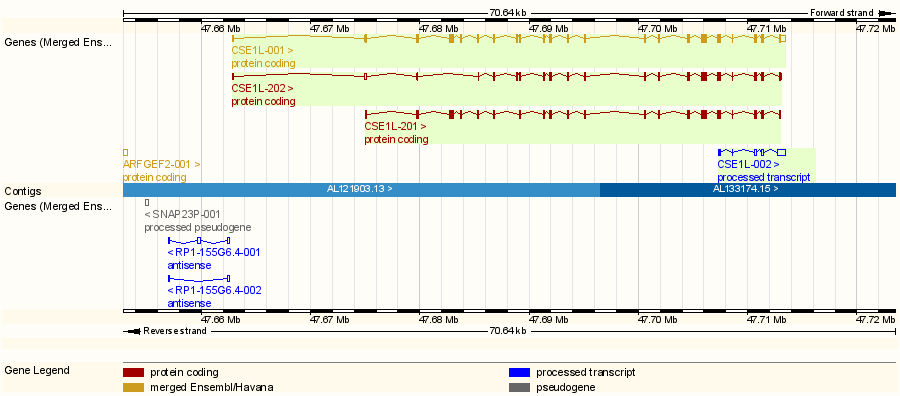
| Gene Type | protein coding |
|---|---|
| Gene Family | Exportins |
| Description | Proteins that carry a nuclear localization signal (NLS) are transported into the nucleus by the importin-alpha/beta heterodimer. Importin-alpha binds the NLS, while importin-beta mediates translocation through the nuclear pore complex. After translocation, RanGTP binds importin-beta and displaces importin-alpha. Importin-alpha must then be returned to the cytoplasm, leaving the NLS protein behind. The protein encoded by this gene binds strongly to NLS-free importin-alpha, and this binding is released in the cytoplasm by the combined action of RANBP1 and RANGAP1. In addition, the encoded protein may play a role both in apoptosis and in cell proliferation. Alternatively spliced transcript variants have been found for this gene. [provided by RefSeq, Jan 2012] | Chromosome | 20 |
| Location | 20q13 |
| Start | 49046246 |
| End | 49096960 |
| Strand | + |
| Gene Sequence | Download Select all |
| Length | 50715 |
| OMIM ID | 601342 |
| HGNC ID | HGNC:2431 |
| Unigene ID | Hs.90073 |
| Ensembl ID | ENSG00000124207 |
| PharmGKB ID | - |
mRNA Information
| mRNA ID | NM_001316.3 |
|---|---|
| Exon | join(1..178,12208..12303,16957..17099,19947..20048, 20120..20265,20945..21035,22470..22577,23960..24052, 26041..26208,26323..26452,28540..28605,29073..29275, 30735..30819,32316..32377,37781..37917,39038..39141, 41764..41861,43002..43152,43293..43501,44497..44594, 44692..44777,45801..45882,47895..48041,48487..48718, 50104..50715) | mRNA Sequence | Download Select all |
| Length | 3627 |
CDS Information
| Location | join(12219..12303,16957..17099,19947..20048,20120..20265, 20945..21035,22470..22577,23960..24052,26041..26208, 26323..26452,28540..28605,29073..29275,30735..30819, 32316..32377,37781..37917,39038..39141,41764..41861, 43002..43152,43293..43501,44497..44594,44692..44777, 45801..45882,47895..48041,48487..48718,50104..50193) |
|---|---|
| CDS Sequence | Download Select all |
| CCDS ID | CCDS13412.1 |
Protein Information
| Protein ID | NP_001243064.1 |
|---|---|
| Protein Name | CSE1 chromosome segregation 1-like (yeast) |
| Molecular Wt. (Da) | 103749 |
| Protein Sequence | Download Select all |
| Length | 915 |
| Uniprot ID | P10275 |
| Ensembl Protein ID | ENSP00000379358 |
Post-translational Modification Information (Source : HPRD)
| Residue | Type | site |
|---|---|---|
| K | Acetylation | 574 |
| K | Acetylation | 824 |
| K | Acetylation | 158 |
| K | Acetylation | 158 |
| T | Phosphorylation | 12 |
| T | Phosphorylation | 18 |
| T | Phosphorylation | 12 |
| T | Phosphorylation | 18 |
Enzyme Information
No matching records could be found.
PPi Information
(Click to view network : Source STRING) View
| Interactant Gene ID (Source: HPRD) | Gene Symbol | HPRD ID | Ref Seq ID | Technique | References |
|---|---|---|---|---|---|
| 999 | CDH1 | 1885 | BAA88957.1 | in vivo | 12061792 |
| 3191 | HNRNPL | 4360 | NP_001524.2 | yeast 2-hybrid | 16169070 |
| 5536 | PPP5C | 2805 | NP_006238.1 | yeast 2-hybrid | 16169070 |
| 5901 | RAN | 3109 | NP_006316.1 | in vitro | 9323134 |
| 6146 | RPL22 | 1602 | NP_000974.1 | yeast 2-hybrid | 16169070 |
| 6772 | STAT1 | 2777 | NP_009330.1 | in vivo | 11927559 |
| 80021 | TMEM62 | 8669 | NP_079232.3 | yeast 2-hybrid | 16169070 |
Pathway Information
No matching records could be found.
Structure Information
No matching records could be found.
Domain Information
| ID | Location | Description |
|---|---|---|
| pfam03378 | 527-962 | CAS_CSE1 |
| cl04032 | 527-962 | CAS_CSE1 superfamily |
| pfam08506 | 156-526 | Cse1 |
| cl20359 | 156-526 | Cse1 superfamily |
| smart00913 | 29-102 | IBN_N |
| cl04271 | 29-102 | IBN_N superfamily |
| COG5657 | 21-935 | CSE1 |
| COG5656 | 9-767 | SXM1 |
Ontology Information
| HPRD ID | 2437 |
|---|---|
| Molecular Class | Transport/cargo protein |
| Molecular Function | Ligand-dependent nuclear receptor activity (GO:0004879) |
| Biological Process | Cell communication (GO:0007154); Signal transduction (GO:0007165) |
Drug Information
No matching records could be found.