
Search results:
General Information
| Gene_Symbol | Gene_ID | Gene_Name | Chromosome | Alias |
|---|---|---|---|---|
| ERCC2 | 2068 | excision repair cross-complementing rodent repair deficiency, complementation group 2 | 19 | EM9; TTD; XPD; COFS2 |
- Evidence
- Gene
- mRNA
- CDS
- Protein
- PTM
- Enzyme
- PPi
- Pathway
- Structural
- Domain
- Ontology
- SNP
- Drug
- External Links
Evidence Information
| Pubmed ID | Year | Sample Information | Techniques | Mechanism | Fold Change | Remark |
|---|---|---|---|---|---|---|
| 19253033 | 2009 | Cell line : - Source : Pathology Departmentof the Clinical County Hospital of Targu-Mures, Romania. Sample Type : CRC tumor and Normal tissue No. of Sample : 117 colon adenomas and 149 colon carcinomas Stage : - | Imunohistochemistry | Down-regulation | - | Decreasing expression of E-cadherin and syndecan-1 during colon carcinoma progression. |
| 20193112 | 2010 | Cell line : - Source : Department of General Surgery,Qingdao Municipal Hospital China. Sample Type : CRC tumor and Normal tissue No. of Sample : 49 Stage : - | RT-PCR | Down-regulation | - | No syndecan ?1 mRNA expression was detected in human colon cancer cell line SW480. With increased in tumor malignancy, syndecan ?1 expression gradually decreased. In tumor tissue that is poorly differentiated, strongly invasive, or with distant metastasis with advanced TNM staging, the expression of syndecan?1 reduced or even was absent. The two markers were involved in the occurrence and development of colon tumors, and may be related to invasion and metastasis of tumor cells. |
| 22994779 | 2012 | Cell line : - Source : - Sample Type : CRC tumor and Normal tissue No. of Sample : 335 primary advanced colorectal carcinoma (including 182 colon and 153 rectal cancer patients) Stage : - | genotyping | Polymorhpism | - | GSTP1 Val/Val, ERCC1 C/C and ERCC2 G/G were significantly associated with better survival of colorectal cancer, and these three gene polymorphisms could be used as predictive markers for the prognosis of colorectal cancer |
Gene Details
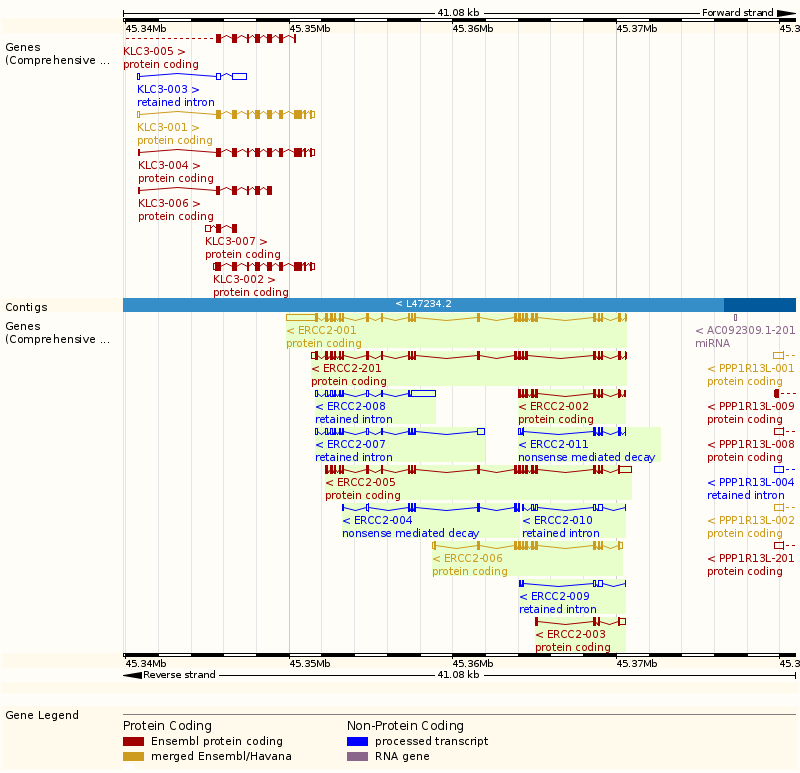
| Gene Type | protein coding |
|---|---|
| Gene Family | - |
| Description | The nucleotide excision repair pathway is a mechanism to repair damage to DNA. The protein encoded by this gene is involved in transcription-coupled nucleotide excision repair and is an integral member of the basal transcription factor BTF2/TFIIH complex. The gene product has ATP-dependent DNA helicase activity and belongs to the RAD3/XPD subfamily of helicases. Defects in this gene can result in three different disorders, the cancer-prone syndrome xeroderma pigmentosum complementation group D, trichothiodystrophy, and Cockayne syndrome. Alternatively spliced transcript variants encoding different isoforms have been found for this gene. [provided by RefSeq, Aug 2008] | Chromosome | 19 |
| Location | 19q13.3-q1 |
| Start | 45351391 |
| End | 45370646 |
| Strand | - |
| Gene Sequence | Download Select all |
| Length | 19256 |
| OMIM ID | 126340 |
| HGNC ID | HGNC:3434 |
| Unigene ID | Hs.487294 |
| Ensembl ID | ENSG00000104884 |
| PharmGKB ID | PA27848 |
mRNA Information
| mRNA ID | NM_177417.2 |
|---|---|
| Exon | complement(<19127..>19256) | mRNA Sequence | Download Select all |
| Length | 2568 |
Protein Information
| Protein ID | NP_000391.1 |
|---|---|
| Protein Name | excision repair cross-complementing rodent repair deficiency, complementation group 2 |
| Molecular Wt. (Da) | 86778 |
| Protein Sequence | Download Select all |
| Length | 760 |
| Uniprot ID | Q13323 |
| Ensembl Protein ID | ENSP00000216115 |
Post-translational Modification Information (Source : HPRD)
No matching records could be found.
Enzyme Information
No matching records could be found.
PPi Information
(Click to view network : Source STRING) View
| Interactant Gene ID (Source: HPRD) | Gene Symbol | HPRD ID | Ref Seq ID | Technique | References |
|---|---|---|---|---|---|
| 983 | CDK1 | 302 | NP_001777.1 | in vivo | 8652557 |
| 5888 | RAD51 | 1557 | NP_597994.3 | in vivo | 12359753 |
Pathway Information
| Pathway Name | Pathway ID |
|---|---|
| Basal transcription factors | hsa03022 |
| Nucleotide excision repair | hsa03420 |
Structure Information
No matching records could be found.
Domain Information
| ID | Location | Description |
|---|---|---|
| smart00488 | 8-280 | DEXDc2 |
| cl21455 | 8-280 | P-loop_NTPase superfamily |
| pfam06777 | 268-413 | DUF1227 |
| cl06029 | 268-413 | DUF1227 superfamily |
| smart00491 | 542-686 | HELICc2 |
| cl21455 | 542-686 | P-loop_NTPase superfamily |
| pfam06733 | 72-256 | DEAD_2 |
| pfam13307 | 524-700 | Helicase_C_2 |
| TIGR00604 | 7-708 | rad3 |
| COG1199 | 8-711 | DinG |
| TIGR01407 | 445-692 | dinG_rel |
| PRK11747 | 190-683 | dinG |
Ontology Information
| HPRD ID | 4547 |
|---|---|
| Molecular Class | DNA repair protein |
| Molecular Function | Receptor signaling complex scaffold activity (GO:0030159) |
| Biological Process | Apoptosis (GO:0006915) |
Drug Information
No matching records could be found.