
Search results:
General Information
| Gene_Symbol | Gene_ID | Gene_Name | Chromosome | Alias |
|---|---|---|---|---|
| KIR2DS5 | 3810 | killer cell immunoglobulin-like receptor, two domains, short cytoplasmic tail, 5 | 19 | nkat9, CD158G |
- Evidence
- Gene
- mRNA
- CDS
- Protein
- PTM
- Enzyme
- PPi
- Pathway
- Structural
- Domain
- Ontology
- SNP
- Drug
- External Links
Evidence Information
| Pubmed ID | Year | Sample Information | Techniques | Mechanism | Fold Change | Remark |
|---|---|---|---|---|---|---|
| 24998207 | 2014 | Cell line : - Source : Korean colorectal cancer patients and a control group. Sample Type : DNA samples from peripheral blood cell No. of Sample : - Stage : - | PCR-SSP | Down-regulation | - | KIR2DS2 in presence of its ligand (HLA-C1 group) may have a protective effect against colorectal cancer. |
Gene Details
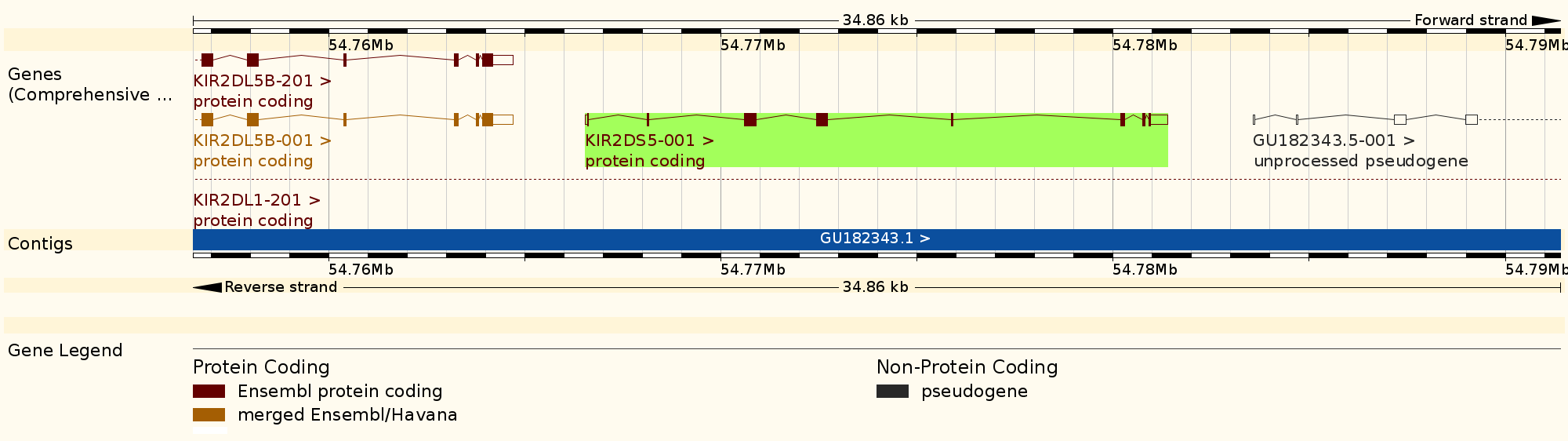
| Gene Type | protein coding |
|---|---|
| Gene Family | Killer cell immunoglobulin-like receptors, "CD molecules", "Immunoglobulin superfamily / Immunoglobulin-like domain containing" |
| Description | Killer cell immunoglobulin-like receptors (KIRs) are transmembrane glycoproteins expressed by natural killer cells and subsets of T cells. The KIR genes are polymorphic and highly homologous and they are found in a cluster on chromosome 19q13.4 within the 1 Mb leukocyte receptor complex (LRC). The gene content of the KIR gene cluster varies among haplotypes, although several "framework" genes are found in all haplotypes (KIR3DL3, KIR3DP1, KIR3DL4, KIR3DL2). The KIR proteins are classified by the number of extracellular immunoglobulin domains (2D or 3D) and by whether they have a long (L) or short (S) cytoplasmic domain. KIR proteins with the long cytoplasmic domain transduce inhibitory signals upon ligand binding via an immune tyrosine-based inhibitory motif (ITIM), while KIR proteins with the short cytoplasmic domain lack the ITIM motif and instead associate with the TYRO protein tyrosine kinase binding protein to transduce activating signals. The ligands for several KIR proteins are subsets of HLA class I molecules; thus, KIR proteins are thought to play an important role in regulation of the immune response. [provided by RefSeq, Jul 2008] | Chromosome | 19 |
| Location | 19q13.4 al |
| Start | 98112 |
| End | 113132 |
| Strand | + |
| Gene Sequence | Download Select all |
| Length | 15021 |
| OMIM ID | 604956 |
| HGNC ID | HGNC:6337 |
| Unigene ID | - |
| Ensembl ID | - |
| PharmGKB ID | - |
mRNA Information
| mRNA ID | NM_014513.2 |
|---|---|
| Exon | join(1..44,1521..1556,4001..4300,5829..6122,9270..9320, 13586..13690,14153..14205,14304..14589) | mRNA Sequence | Download Select all |
| Length | 1602 |
Protein Information
| Protein ID | NP_055328.2 |
|---|---|
| Protein Name | killer cell immunoglobulin-like receptor, two domains, short cytoplasmic tail, 5 |
| Molecular Wt. (Da) | 0 |
| Protein Sequence | Download Select all |
| Length | 304 |
| Uniprot ID | |
| Ensembl Protein ID |
Post-translational Modification Information (Source : HPRD)
No matching records could be found.
Enzyme Information
No matching records could be found.
PPi Information
No STRING Network could be found.
No matching records from HPRD source could be found.
Pathway Information
| Pathway Name | Pathway ID |
|---|---|
| Antigen processing and presentation | hsa04612 |
| Natural killer cell mediated cytotoxicity | hsa04650 |
Structure Information
No matching records could be found.
Domain Information
No matching records could be found.
Ontology Information
| HPRD ID | 4066 |
|---|---|
| Molecular Class | Cell surface receptor |
| Molecular Function | Protein serine/threonine kinase activity (GO:0004674) |
| Biological Process | Cell communication (GO:0007154); Signal transduction (GO:0007165) |
Drug Information
No matching records could be found.