
Search results:
General Information
| Gene_Symbol | Gene_ID | Gene_Name | Chromosome | Alias |
|---|---|---|---|---|
| SMAD7 | 4092 | SMAD family member 7 | 18 | CRCS3; MADH7; MADH8 |
- Evidence
- Gene
- mRNA
- CDS
- Protein
- PTM
- Enzyme
- PPi
- Pathway
- Structural
- Domain
- Ontology
- SNP
- Drug
- External Links
Evidence Information
| Pubmed ID | Year | Sample Information | Techniques | Mechanism | Fold Change | Remark |
|---|---|---|---|---|---|---|
| 23104301 | 2012 | Cell line : - Source : - Sample Type : Case cnotrol study No. of Sample : 1509 CRC cases and 2307 controls Stage : - | TaqMan assay, Logistic regression | Mutation | - | The minor allele (G) of rs4939827, a SMAD7 (18q21) intronic variant, is associated with a lower risk of developing colorectal cancer (CRC) and poorer survival after diagnosis. Individuals with this SMAD7 variant that develop CRC are more probably to have tumors with greater invasiveness and methylation of RUNX3, which potentially contributes to their poorer observed survival. |
| 21102417 | 2011 | Cell line : - Source : University Clinic Schleswig-Holstein, Campus L?beck. Sample Type : - No. of Sample : Adenoma specimens 18 patients without synchronous or subsequent carcinoma and from 23 patients with synchronous carcinoma, as well as 6 related carcinoma samples Stage : TNM Stage I-IV | Multicolor FISH, Immunohistochemistry, Hedley Method | Mutation | - | Smad 7 genomic instability identified. |
| 19395656 | 2009 | Cell line : - Source : - Sample Type : - No. of Sample : - Stage : - | Genotyping, EMSA | Polymorhpism | - | The colorectal cancer risk at 18q21 is caused by a novel variant altering SMAD7 expression. A novel C to G single nucleotide polymorphism (SNP) at 44,703,563 bp was maximally associated with CRC risk. |
| 21221812 | 2011 | Cell line : - Source : Han Chinese population. Sample Type : - No. of Sample : 641 cases and 1037 controls Stage : - | Genome-wide association. | Polymorhpism | - | SMAD7 has been demonstrated to antagonize TGF-B-mediated fibrosis, carcinogenesis, and inflammation. rs12953717 SNP of Smad7 was strongly associated with the colorectal, gastric, and lung cancers. |
| 21910156 | 2011 | Cell line : - Source : Institute of Cancer Research,The National Study of Colorectal Cancer Genetics (NSCCG) and Royal Marsden Hospital Trust/Institute of Cancer Research Family History and DNA Registry. Sample Type : Case control study No. of Sample : 2532 CRC cases and 2607 healthy Stage : - | Genotyping | Polymorhpism | - | 727 cases were genotyped for two GWAS hits in SMAD7 with minor allele frequency > 30%, one with minor allele associated with decreased risk (rs4939827) and one with minor allele associated with increased risk (rs4464148). SMAD7 variants known to be important for CRC risk were associated with disease-specific survival among prediagnostic NSAID users. Case-control study of CRC incidence from 13 counties in Washington State of eligible women, ages 50-74 years. |
| 22580541 | 2012 | Cell line : - Source : Han Chinese population. Sample Type : Case control study No. of Sample : - Stage : - | Cox regression analysis. | Polymorhpism | - | The minor allele in rs4939827 (SMAD7) was associated with reduced overall survival and disease-specific survival. A variant in SMAD7 could affect progression of CRC. |
| 25640388 | 2015 | Cell line : - Source : 13 counties in Washington State Sample Type : - No. of Sample : 727 cases and control Stage : - | Genotyping of SNPsy PCR-RFLP | Polymorhpism | - | Significant association between CRC risk and the rs4464148 AG genotype. |
| 22457752 | 2012 | Cell line : - Source : - Sample Type : Case control study No. of Sample : 2611 CRC case Stage : - | Meta-analysis, TaqMan SNP Genotyping Assay , RT-PCR | Unknown | - | Significant association of the variant rs4939827 with increased risk of colorectal cancer.males were 59.9% among cases compared with 59.1% among controls. |
| 18781153 | 2008 | Cell line : - Source : Iranian individuals Sample Type : Population based case- control study No. of Sample : CRC among 487 Iranian individuals Stage : - | PCR, Immunohistochemistry | Up-regulation | - | Upregulation of smad7 induces hepatic metastasis in colorectal cancer. Overexpression of Smad7 in colon adenocarcinoma (FET) cells induces tumorigenicity by blocking TGF-beta-induced growth inhibition and apoptosis. |
Gene Details
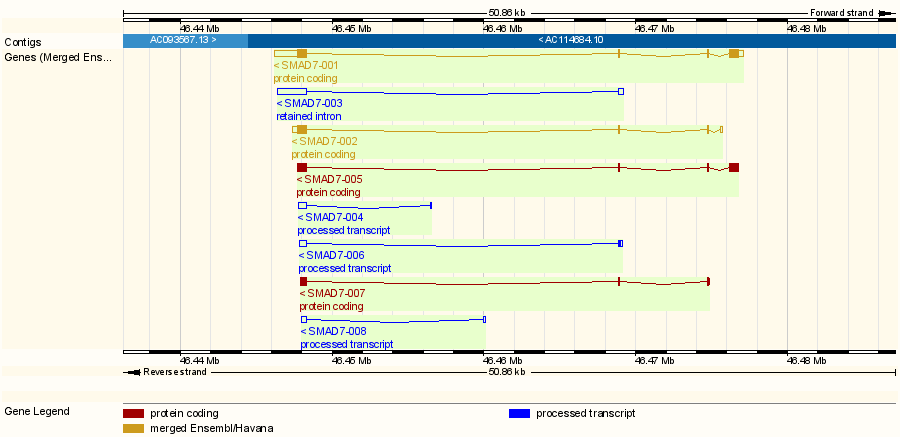
| Gene Type | protein coding |
|---|---|
| Gene Family | SMADs |
| Description | The protein encoded by this gene is a nuclear protein that binds the E3 ubiquitin ligase SMURF2. Upon binding, this complex translocates to the cytoplasm, where it interacts with TGF-beta receptor type-1 (TGFBR1), leading to the degradation of both the encoded protein and TGFBR1. Expression of this gene is induced by TGFBR1. Variations in this gene are a cause of susceptibility to colorectal cancer type 3 (CRCS3). Several transcript variants encoding different isoforms have been found for this gene. [provided by RefSeq, Jun 2010] | Chromosome | 18 |
| Location | 18q21.1 |
| Start | 48919853 |
| End | 48950711 |
| Strand | - |
| Gene Sequence | Download Select all |
| Length | 30859 |
| OMIM ID | 602932 |
| HGNC ID | HGNC:6773 |
| Unigene ID | Hs.465087 |
| Ensembl ID | ENSG00000101665 |
| PharmGKB ID | PA30530 |
mRNA Information
| mRNA ID | NM_001190821.1 |
|---|---|
| Exon | join(1..900,2275..2328,8160..8231,28802..30859) | mRNA Sequence | Download Select all |
| Length | 3085 |
CDS Information
| Location | join(288..900,2275..2328,8160..8231,28802..29340) |
|---|---|
| CDS Sequence | Download Select all |
| CCDS ID | - |
Protein Information
| Protein ID | NP_001177750.1 |
|---|---|
| Protein Name | SMAD family member 7 |
| Molecular Wt. (Da) | 46224 |
| Protein Sequence | Download Select all |
| Length | 425 |
| Uniprot ID | P11802 |
| Ensembl Protein ID | ENSP00000257904 |
Post-translational Modification Information (Source : HPRD)
| Residue | Type | site |
|---|---|---|
| K | Acetylation | 64 |
| K | Acetylation | 70 |
Enzyme Information
No matching records could be found.
PPi Information
(Click to view network : Source STRING) View
| Interactant Gene ID (Source: HPRD) | Gene Symbol | HPRD ID | Ref Seq ID | Technique | References |
|---|---|---|---|---|---|
| 91 | ACVR1B | 3193 | NP_004293.1 | in vivo | 12023024 |
| 1432 | MAPK14 | 2619 | NP_001306.1 | in vitro;in vivo | 12589052 |
| 2033 | EP300 | 4078 | NP_001420.2 | in vitro;in vivo | 12408818 |
| 4091 | SMAD6 | 4240 | NP_005576.3 | in vitro;in vivo;yeast 2-hybrid | 9256479 |
| 4654 | MYOD1 | 1166 | NP_002469.2 | yeast 2-hybrid | 15231748 |
| 5606 | MAP2K3 | 3816 | NP_659732.1 | in vitro;in vivo | 12589052 |
| 5608 | MAP2K6 | 3155 | NP_002749.2 | in vivo | 12589052 |
| 6660 | SOX5 | 18086 | NP_008871.3 | yeast 2-hybrid | 15231748 |
| 6885 | MAP3K7 | 4011 | NP_663304.1 | in vivo | 12589052 |
| 7046 | TGFBR1 | 1822 | NP_004603.1 | in vitro;in vivo | 921 563 815 148 321 |
| 7048 | TGFBR2 | 1823 | NP_001020018.1 | in vitro;in vivo | 11163210 |
| 7270 | TTF1 | 2866 | NP_031370.2 | yeast 2-hybrid | 15231748 |
| 8458 | TTF2 | 5280 | NP_003585.3 | yeast 2-hybrid | 15231748 |
| 9580 | SOX13 | 9205 | AAC83687.1 | yeast 2-hybrid | 15231748 |
| 10454 | MAP3K7IP1 | 4012 | NP_006107.1 | in vivo | 11737269 |
| 27107 | ZBTB11 | 15690 | NP_055230.2 | yeast 2-hybrid | 15231748 |
| 29068 | ZBTB44 | 13692 | NP_054874.3 | yeast 2-hybrid | 15231748 |
| 51427 | ZNF107 | 18669 | NP_001013768.1 | yeast 2-hybrid | 15231748 |
| 55870 | ASH1L | 6416 | NP_060959.2 | yeast 2-hybrid | 15231748 |
Pathway Information
| Pathway Name | Pathway ID |
|---|---|
| Hippo signaling pathway | hsa04390 |
| TGF-beta signaling pathway | hsa04350 |
Structure Information
| PDB ID | 2DJY |
|---|---|
| Resolution | - |
| Method | solution NMR |
| Chains | A |
| Molecule | Smad ubiquitination regulatory factor 2 |
| Model | View |
Domain Information
| ID | Location | Description |
|---|---|---|
| cd10500 | 254-424 | MH2_SMAD_7 |
| cl00056 | 254-424 | MH2 superfamily |
| cd10494 | 60-205 | MH1_SMAD_7 |
| cl00055 | 60-205 | MH1 superfamily |
| cd10496 | 261-424 | MH2_I-SMAD |
| cd10499 | 256-424 | MH2_SMAD_6 |
| pfam03166 | 259-426 | MH2 |
| smart00524 | 260-424 | DWB |
| cd00050 | 261-424 | MH2 |
| smart00523 | 89-205 | DWA |
| cd10489 | 89-205 | MH1_SMAD_6_7 |
| pfam03165 | 92-202 | MH1 |
| cd10493 | 89-205 | MH1_SMAD_6 |
| cd00049 | 89-202 | MH1 |
| cd10495 | 261-421 | MH2_R-SMAD |
| cd10498 | 260-421 | MH2_SMAD_4 |
| cd10985 | 261-424 | MH2_SMAD_2_3 |
| cd10497 | 260-424 | MH2_SMAD_1_5_9 |
| cd10488 | 98-201 | MH1_R-SMAD |
| cd10492 | 98-200 | MH1_SMAD_4 |
| cd10491 | 98-201 | MH1_SMAD_2_3 |
| cd10490 | 98-201 | MH1_SMAD_1_5_9 |
Ontology Information
| HPRD ID | 2867 |
|---|---|
| Molecular Class | Transcription regulatory protein |
| Molecular Function | Kinase regulator activity (GO:0019207) |
| Biological Process | Cell communication (GO:0007154); Signal transduction (GO:0007165) |
Drug Information
No matching records could be found.