
Search results:
General Information
| Gene_Symbol | Gene_ID | Gene_Name | Chromosome | Alias |
|---|---|---|---|---|
| TGFB1 | 7040 | transforming growth factor, beta 1 | 19 | CED, TGFbeta |
- Evidence
- Gene
- mRNA
- CDS
- Protein
- PTM
- Enzyme
- PPi
- Pathway
- Structural
- Domain
- Ontology
- SNP
- Drug
- External Links
Evidence Information
| Pubmed ID | Year | Sample Information | Techniques | Mechanism | Fold Change | Remark |
|---|---|---|---|---|---|---|
| 12174377 | 2002 | Cell line : - Source : - Sample Type : CRC tumor and normal tissue No. of Sample : 50 patients with colorectal cancer and 30 healthy volunteers Stage : Biomarker | ELISA, immunohistochemistry | Up-regulation | - | TGFbeta1 may be used as a possible biomarker. Serum levels of TGFbeta1 in patients with colorectal cancer(40+/-18 microg.L(-1)) were significantly higher than those in the healthy control group(19+/-8 microg.L(-1)), P<0.05. |
| 12046078 | 2002 | Cell line : - Source : - Sample Type : CRC tumor and normal tissue No. of Sample : 98 colorectal cancer Stage : - | Immunohistochemistry | Up-regulation | - | TGF beta(1) might be associated with tumor progression by modulating the angiogenesis in colorectal cancer and TGF beta(1) may be used as a possible biomarker. |
Gene Details
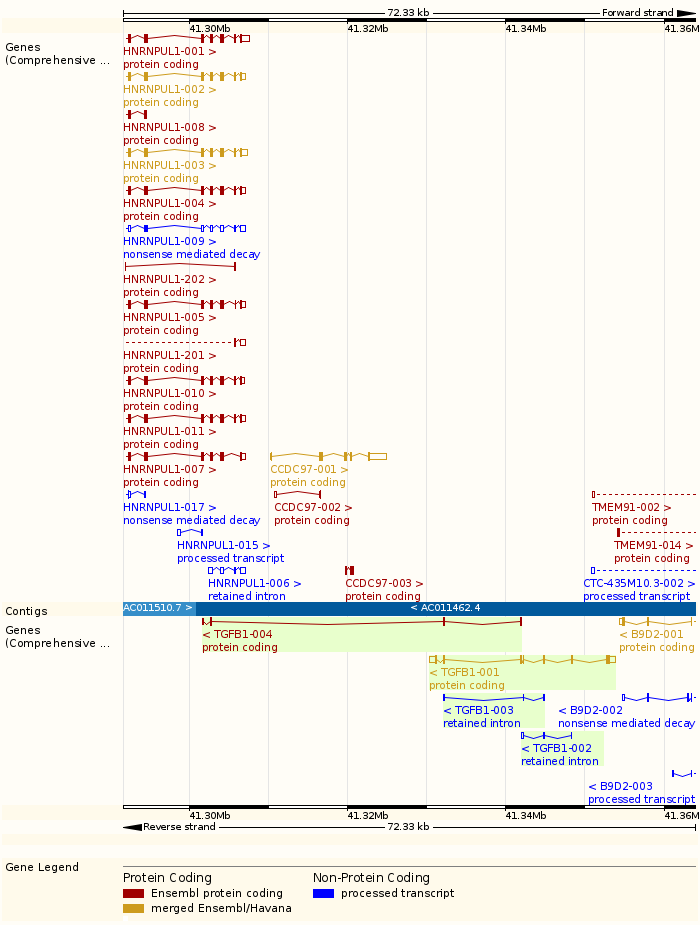
| Gene Type | protein coding |
|---|---|
| Gene Family | Endogenous ligands |
| Description | This gene encodes a member of the transforming growth factor beta (TGFB) family of cytokines, which are multifunctional peptides that regulate proliferation, differentiation, adhesion, migration, and other functions in many cell types. Many cells have TGFB receptors, and the protein positively and negatively regulates many other growth factors. The secreted protein is cleaved into a latency-associated peptide (LAP) and a mature TGFB1 peptide, and is found in either a latent form composed of a TGFB1 homodimer, a LAP homodimer, and a latent TGFB1-binding protein, or in an active form composed of a TGFB1 homodimer. The mature peptide may also form heterodimers with other TGFB family members. This gene is frequently upregulated in tumor cells, and mutations in this gene result in Camurati-Engelmann disease. | Chromosome | 19 |
| Location | 19q13.1 |
| Start | 41330531 |
| End | 41353933 |
| Strand | - |
| Gene Sequence | Download Select all |
| Length | 23403 |
| OMIM ID | 190180 |
| HGNC ID | HGNC:11766 |
| Unigene ID | Hs.645227 |
| Ensembl ID | ENSG00000105329 |
| PharmGKB ID | - |
mRNA Information
| mRNA ID | NM_000660.5 |
|---|---|
| Exon | join(1..1244,5479..5639,9070..9187,11687..11764, 11904..12051,21653..21806,22724..23403) | mRNA Sequence | Download Select all |
| Length | 2583 |
CDS Information
| Location | join(890..1244,5479..5639,9070..9187,11687..11764, 11904..12051,21653..21806,22724..22882) |
|---|---|
| CDS Sequence | Download Select all |
| CCDS ID | CCDS33031.1 |
Protein Information
| Protein ID | NP_000651.3 |
|---|---|
| Protein Name | transforming growth factor, beta 1 |
| Molecular Wt. (Da) | 28491 |
| Protein Sequence | Download Select all |
| Length | 390 |
| Uniprot ID | P08833 |
| Ensembl Protein ID | ENSP00000275525 |
Post-translational Modification Information (Source : HPRD)
| Residue | Type | site |
|---|---|---|
| N | Glycosylation | 82 |
Enzyme Information
No matching records could be found.
PPi Information
(Click to view network : Source STRING) View
| Interactant Gene ID (Source: HPRD) | Gene Symbol | HPRD ID | Ref Seq ID | Technique | References |
|---|---|---|---|---|---|
| 650 | BMP2 | 206 | NP_001191.1 | in vivo | 11456401 |
| 651 | BMP3 | 208 | NP_001192.2 | in vivo | 9434787 |
| 1280 | COL2A1 | 361 | NP_001835.3 | in vitro | 10085302 |
| 1490 | CTGF | 412 | NP_001892.1 | in vivo | 10457363 |
| 1634 | DCN | 501 | NP_001911.1 | in vitro;in vivo | 76 381 067 798 269 |
| 2022 | ENG | 565 | NP_001108225.1 | in vitro;in vivo | 12015308 |
| 2339 | FNTA | 607 | NP_002018.1 | yeast 2-hybrid | 8599089 |
| 3694 | ITGB6 | 947 | NP_000879.2 | in vivo | 10025398 |
| 4313 | MMP2 | 386 | NP_004521.1 | in vitro;in vivo | 10652271 |
| 6348 | CCL3 | 1656 | NP_002974.1 | in vivo | 8568261 |
| 6678 | SPARC | 1631 | NP_003109.1 | in vitro;in vivo | 15034927 |
| 7057 | THBS1 | 1765 | NP_003237.2 | in vivo | 1550960 |
Pathway Information
| Pathway Name | Pathway ID |
|---|---|
| AGE-RAGE signaling pathway in diabetic complications | hsa04933 |
| Amoebiasis | hsa05146 |
| Cell cycle | hsa04110 |
| Chagas disease (American trypanosomiasis) | hsa05142 |
| Chronic myeloid leukemia | hsa05220 |
| Colorectal cancer | hsa05210 |
| Cytokine-cytokine receptor interaction | hsa04060 |
| Dilated cardiomyopathy | hsa05414 |
| Endocytosis | hsa04144 |
| FoxO signaling pathway | hsa04068 |
| Hepatitis B | hsa05161 |
| Hippo signaling pathway | hsa04390 |
| HTLV-I infection | hsa05166 |
| Hypertrophic cardiomyopathy (HCM) | hsa05410 |
| Inflammatory bowel disease (IBD) | hsa05321 |
| Intestinal immune network for IgA production | hsa04672 |
| Leishmaniasis | hsa05140 |
| Malaria | hsa05144 |
| MAPK signaling pathway | hsa04010 |
| Non-alcoholic fatty liver disease (NAFLD) | hsa04932 |
| Osteoclast differentiation | hsa04380 |
| Pancreatic cancer | hsa05212 |
| Pathways in cancer | hsa05200 |
| Proteoglycans in cancer | hsa05205 |
| Renal cell carcinoma | hsa05211 |
| Rheumatoid arthritis | hsa05323 |
| TGF-beta signaling pathway | hsa04350 |
| Toxoplasmosis | hsa05145 |
| Tuberculosis | hsa05152 |
Structure Information
| PDB ID | 1KLA |
|---|---|
| Resolution | |
| Method | SOLUTION NMR |
| Chains | A, B |
| Molecule | TRANSFORMING GROWTH FACTOR-BETA 1 |
| Model | View |
Domain Information
| ID | Location | Description |
|---|---|---|
| pfam00019 | 290-390 | TGF_beta |
| cl02510 | 290-390 | TGF_beta superfamily |
| pfam00688 | 28-261 | TGFb_propeptide |
| cl02928 | 28-261 | TGFb_propeptide superfamily |
| smart00204 | 293-390 | TGFB |
| PHA02913 | 293-389 | PHA02913 |
Ontology Information
| HPRD ID | 4183 |
|---|---|
| Molecular Class | Ligand |
| Molecular Function | Cell adhesion molecule activity (GO:0005194) |
| Biological Process | Cell communication (GO:0007154); Signal transduction (GO:0007165) |
Drug Information
| Uniprot ID | DrugBank ID | Name | Type |
|---|---|---|---|
| P01137 | DB00070 | Hyaluronidase | BiotechDrug |
| P01137 | DB06205 | Hyaluronidase (Human Recombinant) | BiotechDrug |