
Search results:
General Information
| Gene_Symbol | Gene_ID | Gene_Name | Chromosome | Alias |
|---|---|---|---|---|
| TLR4 | 7099 | Toll-like receptor 4 | 9 | TOLL; CD284; TLR-4; ARMD10 |
- Evidence
- Gene
- mRNA
- CDS
- Protein
- PTM
- Enzyme
- PPi
- Pathway
- Structural
- Domain
- Ontology
- SNP
- Drug
- External Links
Evidence Information
| Pubmed ID | Year | Sample Information | Techniques | Mechanism | Fold Change | Remark |
|---|---|---|---|---|---|---|
| 21920464 | 2011 | Cell line : - Source : ATTC, Division of Gastroenterology, Kliniken Essen-Sd (Essen, Germany). Sample Type : - No. of Sample : - Stage : - | - | Polymorhpism | - | Primary human colon cancers carrying the TLR4-D299G variant showed a more progressive tumor stage distribution when compared with TLR4-WT at initial diagnosis. Significant elevation of the inflammation-/tumor-associated genes STAT3 and Cx43 in association with TLR4-D299G. |
| 22999059 | 2013 | Cell line : - Source : Portuguese Institute of Oncology, Porto (IPOP) and Coimbra (IPOC). Sample Type : CRC tumor and normal tissue No. of Sample : 471 participants: 193 histologically confirmed CRC patients and 278 cancer-free controls Stage : - | polymorphisms genotyping, RT-PCR | Polymorhpism | - | TLR4 299Gly homozygous genotype increasing 3-fold the CRC risk.LR2>C and TLR4 Asp299Gly SNPs significantly influence the risk of CRC development, suggesting that these TLRs SNPs may be genetic susceptibility markers for CRC. |
| 23949880 | 2014 | Cell line : - Source : - Sample Type : CRC tumor and normal tissue No. of Sample : 1,209 colorectal cancer (CRC) cases and 1,218 healthy controls Stage : - | - | Polymorhpism | - | TLR4 polymorphisms may serve as biomarker of disease progression. showed a significant association of D299G with an increased risk of advanced stage (p?=?0.03). Finally, we observed a positive link between D299G and T399I polymorphisms and CRC patients with lymph node (p=0.00024; p=0.0005, respectively) and metastasis (p?=?0.001; p?=?0.002, respectively). |
| 24705379 | 2014 | Cell line : - Source : Tunisian population Sample Type : - No. of Sample : 100 patients with colorectal cancer and 140 healthy controls Stage : - | Meta-analysis | Up-regulation | - | TLR-4 is a promising potential biomarker for the early diagnosis of CRC. TLR-4 mRNA and protein levels in CRC patients were higher than those in healthy controls. |
Gene Details
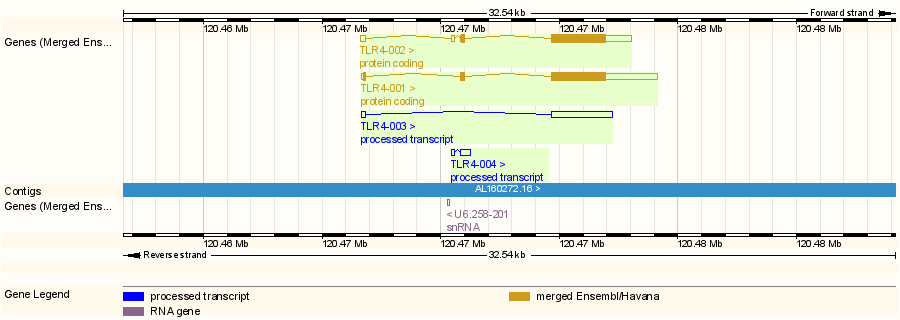
| Gene Type | protein coding |
|---|---|
| Gene Family | CD molecules |
| Description | The protein encoded by this gene is a member of the Toll-like receptor (TLR) family which plays a fundamental role in pathogen recognition and activation of innate immunity. TLRs are highly conserved from Drosophila to humans and share structural and functional similarities. They recognize pathogen-associated molecular patterns that are expressed on infectious agents, and mediate the production of cytokines necessary for the development of effective immunity. The various TLRs exhibit different patterns of expression. This receptor has been implicated in signal transduction events induced by lipopolysaccharide (LPS) found in most gram-negative bacteria. Mutations in this gene have been associated with differences in LPS responsiveness. Multiple transcript variants encoding different isoforms have been found for this gene. [provided by RefSeq, Jan 2012] | Chromosome | 9 |
| Location | 9q33.1 |
| Start | 117704175 |
| End | 117717491 |
| Strand | + |
| Gene Sequence | Download Select all |
| Length | 13317 |
| OMIM ID | 603030 |
| HGNC ID | HGNC:11850 |
| Unigene ID | Hs.174312 |
| Ensembl ID | ENSG00000136869 |
| PharmGKB ID | PA36552 |
mRNA Information
| mRNA ID | NM_003266.3 |
|---|---|
| Exon | join(1..391,4025..4144,4389..4555,8215..13317) | mRNA Sequence | Download Select all |
| Length | 5781 |
CDS Information
| Location | join(299..391,4389..4555,8215..10474) |
|---|---|
| CDS Sequence | Download Select all |
| CCDS ID | CCDS6818.1 |
Protein Information
| Protein ID | NP_003257.1 |
|---|---|
| Protein Name | Toll-like receptor 4 |
| Molecular Wt. (Da) | 91165 |
| Protein Sequence | Download Select all |
| Length | 799 |
| Uniprot ID | P26358 |
| Ensembl Protein ID | ENSP00000345739 |
Post-translational Modification Information (Source : HPRD)
| Residue | Type | site |
|---|---|---|
| N | Glycosylation | 526 |
| N | Glycosylation | 575 |
| S | Phosphorylation | 730 |
| S | Phosphorylation | 690 |
| S | Phosphorylation | 673 |
| S | Phosphorylation | 530 |
Enzyme Information
No matching records could be found.
PPi Information
(Click to view network : Source STRING) View
| Interactant Gene ID (Source: HPRD) | Gene Symbol | HPRD ID | Ref Seq ID | Technique | References |
|---|---|---|---|---|---|
| 929 | CD14 | 1151 | NP_000582.1 | in vivo | 12196527 |
| 3656 | IRAK2 | 4491 | NP_001561.3 | in vivo | 9625770 |
| 4615 | MYD88 | 3703 | NP_002459.2 | in vivo | 1 095 299 411 743 580 |
| 7096 | TLR1 | 3119 | NP_003254.2 | in vivo | 11932926 |
| 7100 | TLR5 | 4326 | NP_003259.2 | in vitro;in vivo | 12794153 |
| 7184 | HSP90B1 | 1860 | NP_003290.1 | in vivo | 11912201 |
| 8767 | RIPK2 | 4585 | NP_003812.1 | in vivo | 15691841 |
| 8915 | BCL10 | 4625 | NP_003912.1 | in vivo | 15213237 |
| 23162 | MAPK8IP3 | 12014 | NP_055948.2 | in vivo | 12941697 |
| 50507 | NOX4 | 9243 | NP_058627.1 | in vitro;yeast 2-hybrid | 15356101 |
| 245812 | CNPY4 | 14611 | NP_689968.1 | in vitro;in vivo | 16338228 |
Pathway Information
| Pathway Name | Pathway ID |
|---|---|
| Amoebiasis | hsa05146 |
| Chagas disease (American trypanosomiasis) | hsa05142 |
| Hepatitis B | hsa05161 |
| HIF-1 signaling pathway | hsa04066 |
| Inflammatory bowel disease (IBD) | hsa05321 |
| Influenza A | hsa05164 |
| Legionellosis | hsa05134 |
| Leishmaniasis | hsa05140 |
| Malaria | hsa05144 |
| Measles | hsa05162 |
| NF-kappa B signaling pathway | hsa04064 |
| Pathogenic Escherichia coli infection | hsa05130 |
| Pertussis | hsa05133 |
| Phagosome | hsa04145 |
| PI3K-Akt signaling pathway | hsa04151 |
| Proteoglycans in cancer | hsa05205 |
| Rheumatoid arthritis | hsa05323 |
| Salmonella infection | hsa05132 |
| Toll-like receptor signaling pathway | hsa04620 |
| Toxoplasmosis | hsa05145 |
| Tuberculosis | hsa05152 |
Structure Information
No matching records could be found.
Domain Information
| ID | Location | Description |
|---|---|---|
| pfam01582 | 676-814 | TIR |
| cl22869 | 676-814 | TIR_2 superfamily |
| smart00255 | 674-815 | TIR |
| pfam13676 | 677-781 | TIR_2 |
| smart00082 | 579-625 | LRRCT |
| cl15307 | 579-625 | LRRCT superfamily |
| cd00116 | 152-456 | LRR_RI |
| cl23707 | 152-456 | LRR_RI superfamily |
| cd00116 | 55-195 | LRR_RI |
| cl23707 | 55-195 | LRR_RI superfamily |
| cd00116 | 372-581 | LRR_RI |
| cl23707 | 372-581 | LRR_RI superfamily |
| pfam12799 | 150-190 | LRR_4 |
| cl19302 | 150-190 | LRR_4 superfamily |
| cd00116 | 59-187 | LRR_RI |
| pfam12799 | 497-538 | LRR_4 |
| cl19302 | 497-538 | LRR_4 superfamily |
| pfam13855 | 78-138 | LRR_8 |
| pfam13855 | 471-532 | LRR_8 |
| pfam13855 | 422-483 | LRR_8 |
| pfam13855 | 373-434 | LRR_8 |
| PLN00113 | 47-532 | PLN00113 |
| COG4886 | 28-190 | LRR |
| pfam13855 | 57-114 | LRR_8 |
| COG4886 | 344-549 | LRR |
| PLN00113 | 349-556 | PLN00113 |
| pfam13855 | 447-508 | LRR_8 |
| PLN00113 | 57-627 | PLN00113 |
| pfam13855 | 102-187 | LRR_8 |
| COG4886 | 41-190 | LRR |
| PLN03150 | 487-583 | PLN03150 |
| pfam13855 | 152-190 | LRR_8 |
| pfam13855 | 399-458 | LRR_8 |
| PLN00113 | 468-579 | PLN00113 |
| pfam14580 | 41-131 | LRR_9 |
Ontology Information
| HPRD ID | 2187 |
|---|---|
| Molecular Class | Cell surface receptor |
| Molecular Function | Peptidase activity (GO:0008233) |
| Biological Process | Protein metabolism (GO:0019538) |
Drug Information
| Uniprot ID | DrugBank ID | Name | Type |
|---|---|---|---|
| O00206 | DB01183 | Naloxone | SmallMoleculeDrug |