
Search results:
General Information
| Gene_Symbol | Gene_ID | Gene_Name | Chromosome | Alias |
|---|---|---|---|---|
| CRYAB | 1410 | Crystallin, alpha B | 11 | CRYA2; CTPP2; HSPB5; CMD1II |
- Evidence
- Gene
- mRNA
- CDS
- Protein
- PTM
- Enzyme
- PPi
- Pathway
- Structural
- Domain
- Ontology
- SNP
- Drug
- External Links
Evidence Information
| Pubmed ID | Year | Sample Information | Techniques | Mechanism | Fold Change | Remark |
|---|---|---|---|---|---|---|
| 20812987 | 2010 | Cell line : - Source : Nanfang Hospital tumour tissue bank. Sample Type : CRC tumor and Normal tissue No. of Sample : 150 Stage : - | Two-dimensional gel electrophoresis, and mass spectrometry,Western blot analysis, Immunohistochemist | Down-regulation | - | This gene differentially expressed in between normal colorectal tissue and colorectal cancer tissue experiment done by 2-D Gel eclectrophotesis |
Gene Details
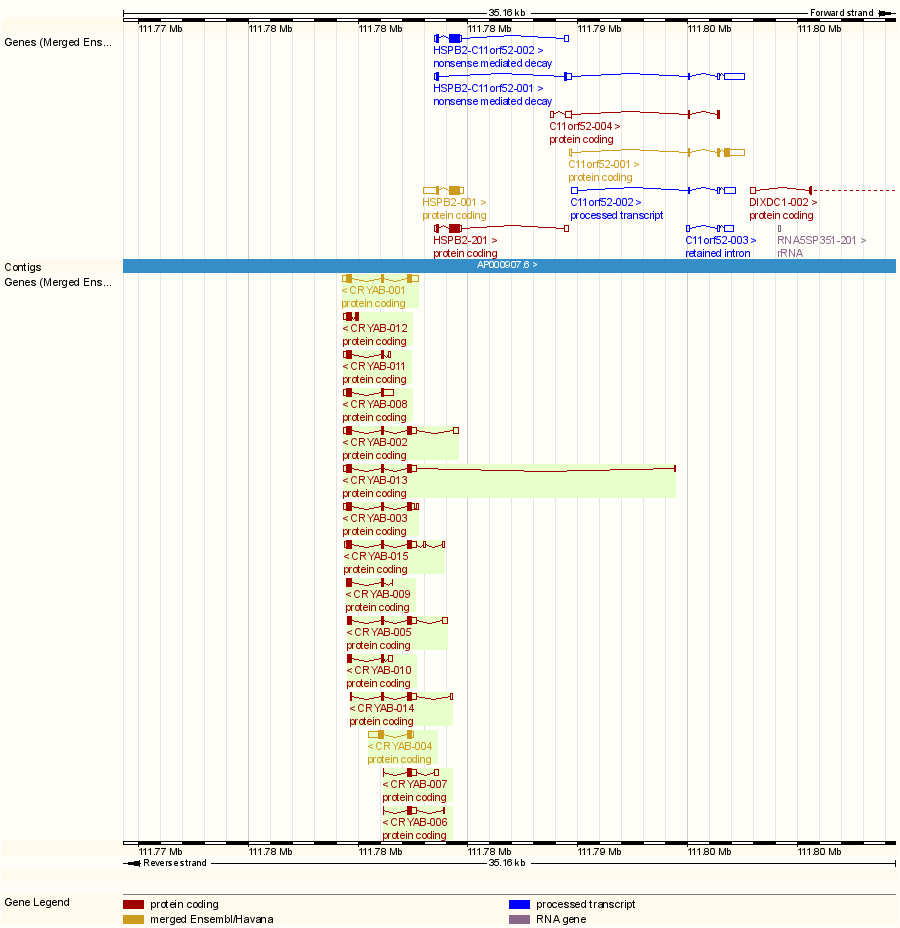
| Gene Type | protein coding |
|---|---|
| Gene Family | Heat shock proteins / HSPB |
| Description | Crystallins are separated into two classes: taxon-specific, or enzyme, and ubiquitous. The latter class constitutes the major proteins of vertebrate eye lens and maintains the transparency and refractive index of the lens. Since lens central fiber cells lose their nuclei during development, these crystallins are made and then retained throughout life, making them extremely stable proteins. Mammalian lens crystallins are divided into alpha, beta, and gamma families; beta and gamma crystallins are also considered as a superfamily. Alpha and beta families are further divided into acidic and basic groups. Seven protein regions exist in crystallins: four homologous motifs, a connecting peptide, and N- and C-terminal extensions. Alpha crystallins are composed of two gene products: alpha-A and alpha-B, for acidic and basic, respectively. Alpha crystallins can be induced by heat shock and are members of the small heat shock protein (sHSP also known as the HSP20) family. They act as molecular chaperones although they do not renature proteins and release them in the fashion of a true chaperone; instead they hold them in large soluble aggregates. Post-translational modifications decrease the ability to chaperone. These heterogeneous aggregates consist of 30-40 subunits; the alpha-A and alpha-B subunits have a 3:1 ratio, respectively. Two additional functions of alpha crystallins are an autokinase activity and participation in the intracellular architecture. Alpha-A and alpha-B gene products are differentially expressed; alpha-A is preferentially restricted to the lens and alpha-B is expressed widely in many tissues and organs. Elevated expression of alpha-B crystallin occurs in many neurological diseases; a missense mutation cosegregated in a family with a desmin-related myopathy. [provided by RefSeq, Jul 2008] | Chromosome | 11 |
| Location | 11q22.3-q2 |
| Start | 111908620 |
| End | 111913213 |
| Strand | - |
| Gene Sequence | Download Select all |
| Length | 4594 |
| OMIM ID | 123590 |
| HGNC ID | HGNC:2389 |
| Unigene ID | Hs.53454 |
| Ensembl ID | ENSG00000109846 |
| PharmGKB ID | - |
mRNA Information
| mRNA ID | NM_001289807.1 |
|---|---|
| Exon | join(1..75,1292..1690,2765..2887,4247..4594) | mRNA Sequence | Download Select all |
| Length | 691 |
CDS Information
| Location | join(1490..1690,2765..2887,4247..4450) |
|---|---|
| CDS Sequence | Download Select all |
| CCDS ID | CCDS8351.1 |
Protein Information
| Protein ID | NP_001276736.1 |
|---|---|
| Protein Name | Crystallin, alpha B |
| Molecular Wt. (Da) | 20028 |
| Protein Sequence | Download Select all |
| Length | 175 |
| Uniprot ID | O43315 |
| Ensembl Protein ID | ENSP00000219919 |
Post-translational Modification Information (Source : HPRD)
| Residue | Type | site |
|---|---|---|
| K | Glycation | 166 |
| K | Glycation | 174 |
| K | Glycation | 175 |
| S | Phosphorylation | 19 |
| S | Phosphorylation | 21 |
| R | Methylation | 22 |
| S | Phosphorylation | 43 |
| S | Phosphorylation | 45 |
| R | Methylation | 50 |
| S | Phosphorylation | 53 |
| S | Phosphorylation | 59 |
| S | Phosphorylation | 76 |
| K | Glycation | 82 |
| K | Acetylation | 92 |
| T | Glycosylation | 170 |
Enzyme Information
No matching records could be found.
PPi Information
(Click to view network : Source STRING) View
| Interactant Gene ID (Source: HPRD) | Gene Symbol | HPRD ID | Ref Seq ID | Technique | References |
|---|---|---|---|---|---|
| 1409 | CRYAA | 427 | NP_000385.1 | in vitro | 11700327 |
| 1431 | CS | 349 | NP_004068.2 | in vitro | 11377425 |
Pathway Information
| Pathway Name | Pathway ID |
|---|---|
| Longevity regulating pathway - multiple species | hsa04213 |
| Protein processing in endoplasmic reticulum | hsa04141 |
Structure Information
No matching records could be found.
Domain Information
| ID | Location | Description |
|---|---|---|
| cd06498 | 67-150 | ACD_alphaB-crystallin_HspB5 |
| cl00175 | 67-150 | alpha-crystallin-Hsps_p23-like superfamily |
| cd06478 | 67-149 | ACD_HspB4-5-6 |
| cd06526 | 71-149 | metazoan_ACD |
| cd06497 | 64-149 | ACD_alphaA-crystallin_HspB4 |
| cd06475 | 64-148 | ACD_HspB1_like |
| pfam00011 | 67-162 | HSP20 |
| pfam00525 | Jan-59 | Crystallin |
| cl02890 | Jan-59 | Crystallin superfamily |
| cd06476 | 71-149 | ACD_HspB2_like |
| cd06464 | 71-149 | ACD_sHsps-like |
| cd06480 | 75-149 | ACD_HspB8_like |
| cd00298 | 60-149 | ACD_sHsps_p23-like |
| cd06481 | 71-149 | ACD_HspB9_like |
| cd06479 | 73-149 | ACD_HspB7_like |
| cd06477 | 71-147 | ACD_HspB3_Like |
| cd06482 | 79-148 | ACD_HspB10 |
| cd06470 | 69-146 | ACD_IbpA-B_like |
| cd06471 | 73-148 | ACD_LpsHSP_like |
| COG0071 | 11-161 | IbpA |
Ontology Information
| HPRD ID | 4223 |
|---|---|
| Molecular Class | Heat shock protein |
| Molecular Function | Water channel activity (GO:0015250) |
| Biological Process | Transport (GO:0006810) |
Drug Information
No matching records could be found.